About 535 minutes
The Papers and Writings of Abraham Lincoln — Volume 5: 1858-1862 — Edition Insights
Historical Psychological Social Fiction
122,997 recorded words. 0 minutes difference from this book's estimate.
View Gutenberg source #2657
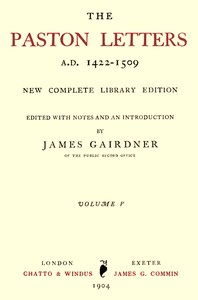
The source record for The Paston Letters, A.D. 1422-1509. Volume 5 (of 6) New Complete Library Edition — Background and Themes measures this digital text at 123,037 words, 8 hr 55 min estimated reading time, and 21 detected text sections.
The text analysis averages about 20.1 words per sentence, while the detected sections provide another way to judge how the source is divided.
Project Gutenberg metadata also associates the work with “England -- Social life and customs -- 1066-1485 -- Sources,” connecting these edition facts with the source record’s subject description.
Explore this collection
These alternatives are selected using recorded categories and estimated reading time.
About 535 minutes
Historical Psychological Social Fiction
122,997 recorded words. 0 minutes difference from this book's estimate.
View Gutenberg source #2657About 539 minutes
Historical Psychological Social Fiction
123,920 recorded words. 4 minutes difference from this book's estimate.
View Gutenberg source #41081About 540 minutes
Historical Psychological Social Fiction
124,041 recorded words. 5 minutes difference from this book's estimate.
View Gutenberg source #40989Search stored excerpts and compare books → Choose by your preferences →
Choices use stored catalog measurements. Estimates vary with reading speed. A shared category is a catalog label, not a claim that two books have the same argument or literary quality.
Search reads excerpt text stored with this catalog and links to its associated Gutenberg record. The connection is stored in the site database; this tool does not recheck that every excerpt is word-for-word identical to that external record. Excerpt search does not cover every chapter and does not verify historical publication dates.
Catalog snapshot checked: 2026-09-25. Coverage: 91 public books, 91 available source excerpts.
Read the complete public-domain text at its original source.
Read on Project GutenbergThe Paston Letters, Volume V, offers a direct encounter with the rhythms of 15th-century English life through correspondence that is at once practical and personal. The letters are not polished literary artifacts but working documents, filled with requests for hawks, updates on timber valuations, and negotiations over property. The editor, James Gairdner, presents these texts with minimal intervention, preserving the original spelling and syntax, so that the reader hears the writers' voices—sometimes pleading, sometimes impatient, always grounded in the specifics of their world.
One letter, for instance, opens with a promise to send a hawk and closes with a postscript dismissing a bird as 'not worth a crowe.' This juxtaposition of earnest negotiation and blunt dismissal is characteristic of the collection, where matters of honor and economy are intertwined. The volume's 21 sections span the years 1422–1509, but the focus remains on the immediate concerns of the Paston family and their correspondents, offering a granular view of social and economic life in late medieval England.
The letters in this volume are marked by a distinctive urgency, often conveyed through direct address and repeated pleas. In one letter, the writer begs for a hawk, promising payment and invoking a lady's favor: 'I requere yow for hyr sake that ye best love of theym all, onys trowbyll yowr syllf for me in thys mater.' The language is both deferential and insistent, a blend of courtesy and pressure. The writer positions himself as a knight in service to a lady, yet the underlying transaction is economic—a hawk to be paid for at Candlemas. This tension between chivalric language and commercial reality recurs throughout the correspondence.
Another letter, from John Osbern to Sir John Paston, is almost entirely concerned with the valuation of wood. Osbern provides a meticulous breakdown of costs: the carpenter's labor at 3s. 4d., the lauded wood valued at £54 7s. 10d., and the total sum of £198 2s. 8d. The tone is factual, but the final warning—'be not to hasty'—reveals the writer's caution. These letters show how personal relationships and business transactions were negotiated through the same medium, with the same intensity.
The letters are dense with references to objects that anchor the correspondence in material reality. A ring is delivered with difficulty; a hawk is promised; a pye (magpie) is heard speaking and judged worthless. These items are not mere props but carry social and economic weight. The ring, for instance, becomes a token of obligation: the recipient 'hathe promyseid me to be more at your comandment then at eny knyghtes in Inglond.' The exchange of goods is inseparable from the exchange of loyalties.
Wood valuations, as in Osbern's letter, are recorded with precision: 'the launde wythin the dykes xij. fote inward fro the cop of the dyke and wythowte at liiij li. vij s. x d.' Such details reveal a world where land and timber were primary forms of wealth, and where every foot of dyke was accounted for. The letters also mention legal documents, such as letters patent for a bridge in Bermondsey Street, indicating the intersection of family business with royal administration. These objects—hawks, rings, timber, charters—are the tangible evidence of the Pastons' social and economic strategies.
One of the most striking features of this volume is the abrupt shifts in tone within a single letter. A writer may move from elaborate courtesy to blunt criticism without transition. In one letter, after a lengthy request for a hawk, the writer adds a postscript: 'I sye the pye, and herd it spek; and, be God, it is not worthe a crowe; it is fer wers then ye wend; be God, it wer shame to kep it in a cage.' The shift from supplication to dismissive judgment is jarring, and it suggests a relationship where frankness was permitted or even expected.
Similarly, the pace of the correspondence varies. Some letters are brief and businesslike, focusing on a single transaction; others are longer, weaving together multiple concerns. The editor's notes, such as 'This P.S. is written on the back of the letter,' remind us that these texts were physical objects, often composed in haste. The reader must adjust to the rhythm of the letters, which can move from detailed accounts to personal asides, from formal address to colloquial speech. This variability is not a flaw but a feature of the collection, reflecting the diverse purposes and moods of the writers.
Readers approaching this volume should be prepared for a text that resists easy summary. The letters do not form a continuous narrative but rather a mosaic of voices and concerns. Pay attention to the postscripts and marginal notes, where writers often reveal their true feelings. The editorial apparatus, including footnotes and typographical corrections, is minimal, so the reader must engage directly with the original language. This is not a work to be read quickly; it rewards those who linger over the details of a timber valuation or the phrasing of a request for a hawk.
In the Paston Letters, a hawk’s price or a ring’s promise often carried more weight than politics; so too, in those old American letters, small daily manners quietly reveal a nation’s character. Both are conversations caught mid-thought, full of urgency and fleeting warmth. Society, Manners and Politics in the United States Being a Series of Letters on North America — Story, Setting & Ideas shares that same intimate, unguarded pulse.
Answer a few questions and save a private reflection on this device.