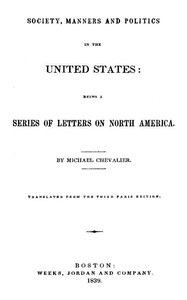
Michel Chevalier, a French engineer sent to inspect American public works in 1834, produced a series of letters that blend travelogue with political economy. The translator's notice reveals that Chevalier extended his two-year stay to study 'the workings of our social and political machinery,' and his observations range from canal dimensions to national character. The opening letter, dated from London, immediately establishes a comparative framework: Chevalier draws analogies between 'certain Political and Voltaic Phenomena' and contrasts French and English approaches to railroads. This sets the tone for a work that treats infrastructure as a lens for understanding American society.
A French Engineer's Gaze on American Works
Chevalier's professional background shapes his narrative. The translator notes he was sent 'under the patronage of Thiers, then Minister of the Interior, in France, to inspect our public works.' This technical lens appears in detailed descriptions of canal dimensions: the Chesapeake and Ohio Canal's 'dimensions exceed those generally adopted in the proportion of 3 to 2, which gives a larger section in the ratio of 9 to 4.' Such precision is not mere data; it reflects Chevalier's method of using engineering specifics to gauge national ambition. He compares the scale of American projects to European counterparts, implicitly measuring the young republic's capacity for grand enterprise. Readers should note how these technical passages alternate with broader social commentary, creating a layered portrait of a nation under construction.
The Political Geography of Internal Improvements
Chevalier treats canals and railroads as political documents. He traces how the Chesapeake and Ohio Canal revived 'the plan, which had been cherished by Washington,' and notes that President John Quincy Adams 'favoured the project with all his might' at a time when federal internal improvements were not yet constitutionally contested. The financial details—Congress voting $1,000,000, Washington city subscribing the same sum despite its small population—reveal the political stakes. Chevalier also observes regional rivalries: Virginia, 'formerly the first State in the confederacy, but now fallen to the fourth in rank,' is 'roused to action' by Northern examples, while 'North Carolina does nothing, and projects nothing.' These passages show how infrastructure debates mapped onto sectional identities long before the Civil War.
Observations on American Manners and Society
Though the excerpts focus on public works, the book's title promises attention to 'Society, Manners and Politics.' The translator emphasizes that Chevalier 'tells many home truths to all parties and classes' and is 'ready to recognise whatever is good or of good tendency.' Even in the canal descriptions, Chevalier's voice emerges through asides: he notes that Cincinnati's citizens are 'enthusiastically interested' in a railroad scheme, and that Georgia 'is dreaming of a great railroad.' These human touches hint at a broader social portrait. Readers should watch for how Chevalier weaves character sketches and cultural observations into his technical narrative, using infrastructure as a stage for examining American energy, boosterism, and regional identity.
The Translator's Role and the Text's Provenance
The translator, T. G. Bradford, explicitly distances himself from Chevalier's opinions while praising his 'diligence and sagacity.' Bradford's note explains that 'some passages of the letters and many of the notes, which have no particular interest in this country, have been omitted.' This editorial intervention means the English edition is a curated selection, not a full translation. Readers should consider how Bradford's choices shape the portrait of America presented here. The work was 'very favourably received in his own country,' suggesting Chevalier's perspective resonated with French audiences. The 1839 Boston edition thus represents a cross-cultural exchange: a French observer's analysis, filtered through an American translator for a domestic readership.
Chevalier's letters reward readers who attend to both the technical details and the comparative framework. The canal dimensions and subscription figures are not dry statistics but evidence of how Americans mobilized capital and political will. The translator's interventions remind us that this is a mediated text, shaped by its intended audience. As you read, consider how Chevalier's position as a foreign engineer—neither fully insider nor outsider—allows him to see patterns that native observers might miss. His observations on infrastructure, politics, and regional character remain a valuable document of Jacksonian America.
The rain kept time with Chevalier’s letters on American railroads, his measured astonishment at our restless building. When I set him down, a quieter volume waited nearby—A Collection of Essays and Fugitiv Writings On Moral, Historical, Political, and Literary Subjects — Themes and Context. His was motion; this, a halt. Both spoke of a young nation, though one preferred the murmur of its own thoughts.