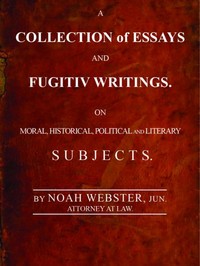
Noah Webster's A Collection of Essays and Fugitiv Writings (1790) opens with a dissertation on language that traces the etymology of the word "God" through Greek, Latin, and Saxon roots, arguing that word origins shape national beliefs. This analytical approach typifies Webster's method: he treats language as a record of cultural evolution, not merely a tool for communication. The collection spans political commentary, historical analysis, and moral instruction, all marked by a direct, argumentative voice that reflects the author's role as a Federalist public intellectual.
Etymological Arguments and National Character
In the dissertation on language, Webster dissects the Greek Theos (from theo, "to run") and the English "God" (from Saxon "good"), contending that such derivations reveal how "the mere use of words has led nations into error." He argues that the Greek term implied a moving principle, while the Saxon term emphasized benevolence—differences that shaped each culture's conception of divinity. This linguistic determinism extends to his political essays, where he frequently ties word choice to civic virtue. For instance, he criticizes imprecise legal language as a threat to republican governance, urging readers to "clear understanding of words" as a safeguard against demagoguery. The excerpts show Webster alternating between scholarly etymology and polemical assertion, a rhythm that keeps the prose urgent despite its eighteenth-century formality.
Pace Shifts Between Moral Instruction and Political Polemic
The collection's pacing varies markedly. The moral essays adopt a measured, didactic tone, with periodic sentences and appeals to reason. In contrast, the political pieces—especially those on the Confederation period—accelerate into sharp, declarative statements. Webster often opens a paragraph with a blunt claim ("Such is the influence of opinion in the formation of language") before unpacking evidence. This technique creates a staccato rhythm that mirrors his argumentative urgency. The excerpts also reveal his habit of posing rhetorical questions, then answering them with historical examples, a structure that sustains momentum. Readers will notice how Webster's voice shifts from the patient explicator of etymology to the impatient reformer, particularly when addressing national education or constitutional flaws.
Recurring Motifs: Education, Unity, and the Public Good
Across the essays, Webster returns to three motifs: the necessity of a national language, the dangers of foreign influence, and the role of education in forming citizens. In the language dissertation, he warns that imported words carry foreign prejudices, a concern that echoes in his political writings about European alliances. The excerpts also show him praising New Haven's "green or public ground" as a model of civic beauty, linking physical space to moral order. These recurring themes give the collection coherence despite its topical range. Webster's voice remains consistent—confident, occasionally pedantic, but always focused on practical reform. The essays do not merely argue; they prescribe, reflecting the author's conviction that written words could shape a nation's character.
Readers approaching this collection should attend to Webster's rhetorical strategies as much as his arguments. His habit of grounding abstract claims in concrete etymologies or local examples makes the eighteenth-century prose accessible, but his partisan edges—especially in political sections—require historical context. The essays reward slow reading: each paragraph builds a case through accumulation of detail, and the shifts in pace signal where Webster feels most invested. For those interested in the intellectual foundations of early American nationalism, this volume offers a direct line to one of its most articulate architects.
That rainy afternoon, Webster’s insistence that words shape a nation’s soul felt almost heavy, a duty pressing down from two centuries ago. Then, idly, I sought the human echo, and found instead The Paston Letters, A.D. 1422-1509. Volume 4 (of 6) New Complete Library Edition — Context and Discussion, where ordinary worries—debts, marriages, a stolen coat—breathe beneath the same grand language. One quiet shelf led, quite by accident, to another.