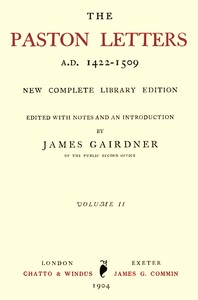
The Paston Letters offer a direct window into the legal and social maneuvers of a 15th-century English gentry family. In this volume, a letter from John Paston to his wife Margaret (September 1450) lays out a dispute with Lord Moleyns over the manor of Gresham. Paston recounts how Moleyns’s men allegedly took over £200 worth of goods, and describes a series of negotiations where Moleyns’s counsel “cowde no forther in the matier.” The letter is a dense record of legal strategy, property claims, and the use of delay as a tactic.
Paston’s language is precise and tactical: he refers to a “writte of restitution,” notes that his counsel “hath alwey conceyved that the tretees he offred hath be to non othir entent but to delaye the matier,” and contrasts his own willingness to submit to judges with Moleyns’s preference for “entrete” (negotiation) aimed at compromise. The letter also includes a postscript about a newborn daughter, grounding the legal drama in family life.
Legal Language and Strategy
The letter from John Paston to Margaret (Letter 168) is a masterclass in 15th-century legal rhetoric. Paston uses terms like “special assise,” “writte of restitution,” and “title” with precision. He reports that his counsel advised him to enter Gresham manor by force but he declines because the manor is “so decayed” by Moleyns’s occupation that its value dropped from 50 marks to £20. This detail reveals how property damage was quantified and used as leverage.
Paston also describes a meeting where “a sergeant and vj. or vij. thrifty apprentisez” were present, indicating the professionalization of legal representation. He accuses Moleyns of using negotiations only to delay, writing that “the tretees he offred hath be to non othir entent but to delaye the matier.” The letter is a strategic document, meant to inform and instruct his wife and possibly to be shown to the Chancellor.
The Role of the Chancellor and Written Records
Paston’s letter repeatedly references the Lord Chancellor (Cardinal Kemp) as the ultimate arbiter. He asks Margaret to “laboure ye so to my Lord Chaunceller” and to deliver a copy of a bill of damages. The letter itself functions as a written record: Paston encloses a copy of the title and answer presented in Parliament, and instructs Margaret to take a copy for herself. This emphasis on documentation—bills, copies, rolls—shows how written evidence was central to legal claims.
The editor’s note that the letter is “printed from a copy in Gresham’s handwriting” highlights the archival nature of the collection. The Paston family preserved these letters as evidence, and the editor’s apparatus (footnotes, cross-references) mirrors the original compilers’ concern with accuracy. The letter’s postscript about a newborn daughter adds a personal touch, but the core is a legal brief.
Family and Network in Dispute Resolution
Paston’s letter is addressed to his wife Margaret, but it also involves a network of allies: “my cosyn William Whyte” is asked to help, and “dyverse men of my freendis” advise him. The letter is meant to be shared—Paston writes “lete hym be prevye to this letter.” This reveals how legal disputes were family affairs, with wives acting as agents and messengers.
The dispute with Lord Moleyns is not isolated; the volume includes other letters, such as Sir John Fastolf’s complaint about damages from the Duke of Suffolk’s officers. The Paston network extends to servants, lawyers, and patrons. The letter’s closing request for a written answer (“lete me have answer from yow in wrytyng”) underscores the importance of correspondence as a tool for coordination and record-keeping.
Readers should approach this volume as a collection of evidence rather than a narrative. The letters are often incomplete, with missing context supplied by the editor’s notes. Pay attention to the dates, addresses, and postscripts—they reveal the practical realities of 15th-century communication. The legal jargon can be dense, but the underlying conflicts over land, money, and honor are timeless. This is not a story but a archive of voices from a world where a letter could be a weapon.
Reading John Paston’s careful delays over Gresham manor, I remembered haggling over my grandfather’s fence line—how silence itself became a argument. Decades earlier, a traveler’s letters in Society, Manners and Politics in the United States Being a Series of Letters on North America — Story, Setting & Ideas gave me that same ache of watching strangers negotiate what home means, their polite words weighing more than they said.