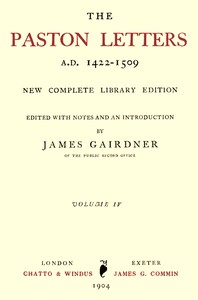
The Paston Letters are not a narrative but a collection of original correspondence, and Volume 4 plunges the reader directly into the family's legal and physical struggles. The letters, written in a mix of Middle English and early modern phrasing, convey urgency through phrases like “Wretyn in hast” and “Plesith it youre maysterschip to witte.” The editor, James Gairdner, provides contextual headnotes that identify senders, recipients, and dates, but the raw voices of the Pastons and their associates dominate. Readers encounter Margaret Paston’s anxious instructions about “zong Heydon reysyth mych pepyl” and Richard Calle’s report of a 300-man confrontation at Heylesdon. These are not polished literary texts; they are functional documents—orders, pleas, and reports—that demand careful attention to names, places, and implied relationships.
Voices of Urgency and Strategy
The letters in this volume are marked by a tone of immediate concern. Margaret Paston writes to her son with directives about accounts and warnings about “Pykyng,” while Richard Calle describes a tense standoff where “we had lx. men withinne the place, and gonnes.” The language is direct and practical: “I wold ze schulde do Rychard Calle hye hym of makeng of alle the acountes.” The writers assume their recipients share a detailed knowledge of local feuds and legal maneuvers. The editor’s notes clarify that “Jhon” is not an error and that “Gresham and Tresham are different people,” signaling that the reader must navigate a web of names. These voices reveal a world where honor, property, and safety are constantly at risk, and where a single letter can carry instructions for defense or negotiation.
Confrontation and Legal Maneuvering
A striking feature of this volume is the detailed accounts of physical confrontations. Richard Calle’s letter describes how “my Lorde of Suffolkes men” attempted to enter Heylesdon with “the nombre of CCC. men,” only to be met by a prepared defense. The writer notes that “my mastres was withinne, and my mastre, Sir John,” and that Sir John “gate hym as grete worschip for that day as any gentleman myght doo.” The incident includes an arrest, a journey to Claxton, and a subsequent threat: “they lye in a wayte for to myscheve me, Dawbeney, and Wyks.” The legal system appears through references to a “warant” and an “Heyre Determyner” to inquire into riots. These passages show how the Pastons relied on both armed readiness and legal processes, and how local power dynamics played out in the countryside around Norwich.
The Editor’s Role and Textual Clues
James Gairdner’s editorial apparatus shapes how a reader approaches the letters. His headnotes identify the manuscript source (e.g., “From Paston MSS., B.M.”) and offer conjectures about dating and context. For instance, he notes that a letter from Margaret Paston is “not addressed on the back” and that the handwriting is not hers, but the subscription suggests it was written to a son. The editor also explains textual features: brackets indicate damaged text, “( sic )” marks odd spellings, and the letter “z” represents the original yogh. Footnotes are numbered by page for cross-referencing with the index. These details remind the reader that the printed text is a reconstruction, and that the original manuscripts contain gaps and ambiguities. The editor’s caution about “invisible” missing letters and recurring misprints (italic “d” misprinted as “a”) underscores the fragility of the historical record.
Reading the Letters as Historical Evidence
These letters are not self-contained stories; they are fragments of ongoing disputes. A single letter may refer to events, people, and places that are not explained within it. For example, Richard Calle’s account assumes knowledge of “the Master Philip and the Balyf of Cossey” and “my Lorde of Norwiche.” The reader must piece together relationships from repeated names and titles. The editor’s cross-references to other volumes (I, II, III, V, VI) indicate that the full picture spans multiple books. The letters also reveal social hierarchies: servants like Calle write with deference (“Plesith it youre maysterschip”), while family members use more direct language. The recurring mention of “my mastres” (Margaret Paston) and “Sir John” shows the family’s active role in managing their affairs. For a first-time reader, the best approach is to read each letter as a piece of a larger puzzle, noting names and places, and using the editor’s notes as a guide.
Reading the Paston Letters requires patience with unfamiliar spellings and abrupt transitions. The reward is direct access to the voices of 15th-century English people—worried mothers, defiant sons, and loyal servants—caught in the midst of land disputes and legal battles. The editor’s notes are essential for understanding context, but the letters themselves carry the emotional weight. Approach each document as a primary source, not a polished story, and let the recurring names and places build a picture of a family fighting to hold onto its property and honor.
I keep thinking about those voices from the fifteenth century, raw and unpolished, arguing over land with such fierce desperation. It feels strangely intimate, like overhearing someone's private worries. That same closeness lingers in The Paston Letters, A.D. 1422-1509. Volume 2 (of 6) New Complete Library Edition — Story, Setting & Ideas, where the family's story settles deeper—less about the disputes, more about the quiet weight of carrying on.