About 405 minutes
The Love Letters of Dorothy Osborne to Sir William Temple, 1652-54 — Edition Insights
Historical Psychological Social Fiction
93,143 recorded words. 36 minutes difference from this book's estimate.
View Gutenberg source #12544
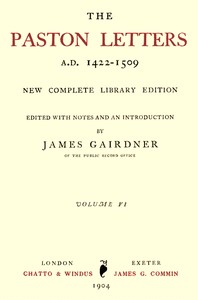
Before opening The Paston Letters, A.D. 1422-1509. Volume 6 (of 6), Part 1 (Letters, Chronological Table) New Complete Library Edition — Inside the Classic, the edition data offers a quick orientation: 84,750 words, 6 hr 9 min estimated reading time, and 17 detected text sections.
The text analysis averages about 16.6 words per sentence, while the detected sections provide another way to judge how the source is divided.
Project Gutenberg metadata also associates the work with “England -- Social life and customs -- 1066-1485 -- Sources,” connecting these edition facts with the source record’s subject description.
Explore this collection
These alternatives are selected using recorded categories and estimated reading time.
About 405 minutes
Historical Psychological Social Fiction
93,143 recorded words. 36 minutes difference from this book's estimate.
View Gutenberg source #12544About 413 minutes
Historical Psychological Social Fiction
94,875 recorded words. 44 minutes difference from this book's estimate.
View Gutenberg source #2811About 317 minutes
Historical Psychological Social Fiction
72,702 recorded words. 52 minutes difference from this book's estimate.
View Gutenberg source #66908Search stored excerpts and compare books → Choose by your preferences →
Choices use stored catalog measurements. Estimates vary with reading speed. A shared category is a catalog label, not a claim that two books have the same argument or literary quality.
Search reads excerpt text stored with this catalog and links to its associated Gutenberg record. The connection is stored in the site database; this tool does not recheck that every excerpt is word-for-word identical to that external record. Excerpt search does not cover every chapter and does not verify historical publication dates.
Catalog snapshot checked: 2026-09-25. Coverage: 91 public books, 91 available source excerpts.
Read the complete public-domain text at its original source.
Read on Project GutenbergThe Paston Letters, Volume 6, Part 1, edited by James Gairdner, presents a collection of 15th-century correspondence that offers a direct window into the lives of the Paston family and their contemporaries. The volume opens with a detailed editorial apparatus, including a note on the text's encoding and a list of typographical conventions, such as the use of brackets and the representation of the letter 'yogh' as 'z'. This meticulous attention to textual accuracy signals that the reader is entering a scholarly edition, where the materiality of the original manuscripts is preserved as much as possible.
The opening pages of this volume establish a clear editorial framework. Gairdner explains that each volume is a separate e-text, with Volume VI divided into two parts: Letters and Index. He notes that brackets, parenthetical question marks, and sic notations are retained from the original, and that series of dots represent damaged text. This transparency about editorial decisions prepares the reader to encounter a text that is not sanitized but rather presented with its historical imperfections. The reader is thus encouraged to approach the letters as artifacts, not merely as narratives. The editor's note also mentions that the year of each letter was originally printed as a sidenote, now merged with the letter's heading—a small but significant detail that helps orient the reader chronologically.
The excerpts reveal that the Paston letters are deeply concerned with practical matters: land disputes, financial transactions, and the management of property. In Letter 1033, William Paston writes to the bailiff of Mautby requesting gold coins be sent in a box disguised as evidence, because the messenger is leaving his service and he does not want him to know his business. This letter illustrates the cautious, even secretive, nature of communication in a world where trust was limited. Similarly, Letter 1034 from the Earl of Oxford to Edmund Paston deals with the division of lands inherited from Lord Scales, appointing Edmund as an impartial receiver of profits. These letters show that correspondence was a tool for managing assets and navigating complex familial and legal relationships.
The letters exhibit a range of voices, from the formal and authoritative tone of the Earl of Oxford to the more direct and personal style of William Paston. The Earl's letter is structured with legal precision, using phrases like 'it is accordid bitwixt me and my said cousin' and 'Yevyng you full auctorite and power'. In contrast, William Paston's note to the bailiff is brisk and colloquial, with instructions to 'sende me be Wylliam Kokkys berer her of, iiij. nobylles in golde'. The use of direct address ('Mayster Baly') and the casual mention of a horse named Bayard add a personal touch. These stylistic differences remind the reader that the collection encompasses a variety of writers, each with their own concerns and modes of expression.
Gairdner's editorial notes provide essential historical context, often speculating on dates and identifying individuals. For instance, he notes that Letter 1033 is dated from Heningham and likely written in 1489, but also raises a doubt about the attribution of the writer, suggesting that Fenn may have confused two Williams. Similarly, for Letter 1034, he explains the descent of the lands of Thomas, Lord Scales, and mentions that William Tyndale was knighted in 1489. These annotations are not merely explanatory; they engage with the scholarly debate about the letters' provenance. The reader is thus invited to consider the letters not as fixed documents but as pieces of evidence that require interpretation and cross-referencing with other sources.
For a first reading, it is helpful to pay attention to the editorial notes as much as to the letters themselves. The notes often clarify the circumstances of each letter and highlight uncertainties in dating or authorship. The volume's structure, with letters arranged chronologically and accompanied by a table, allows the reader to trace events over time. By reading with an awareness of the editorial choices—such as the retention of original spellings and the inclusion of typographical errors—the reader can appreciate the letters as historical documents that have been carefully preserved and presented.
I remember sitting with these letters, struck by how the Pastons’ daily worries—leases, debts, small feuds—felt so close across five centuries. That same ache surfaced reading The negro workers — Key Ideas to Explore, where ordinary lives press against history’s weight. Both books whisper that survival leaves quieter records than glory, yet those records hold us longest.
Save your reaction, strongest insight, and memorable passage.