About 267 minutes
Faces and Places — Background and Themes
Historical Psychological Social Fiction
61,222 recorded words. 50 minutes difference from this book's estimate.
View Gutenberg source #25624
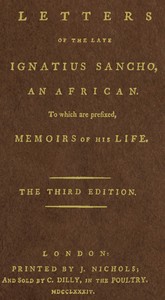
This digital edition of Letters of the Late Ignatius Sancho, an African To Which Are Prefixed, Memoirs of His Life — Text and Context is described by source-level measurements including 72,702 words, 5 hr 17 min estimated reading time, and 168 detected text sections.
The text analysis averages about 23.4 words per sentence, while the detected sections provide another way to judge how the source is divided.
Project Gutenberg metadata also associates the work with “Sancho, Ignatius, 1729-1780 -- Correspondence,” connecting these edition facts with the source record’s subject description.
Explore this collection
These alternatives are selected using recorded categories and estimated reading time.
About 267 minutes
Historical Psychological Social Fiction
61,222 recorded words. 50 minutes difference from this book's estimate.
View Gutenberg source #25624About 369 minutes
Historical Psychological Social Fiction
84,750 recorded words. 52 minutes difference from this book's estimate.
View Gutenberg source #42240About 245 minutes
Historical Psychological Social Fiction
56,130 recorded words. 72 minutes difference from this book's estimate.
View Gutenberg source #35725Search stored excerpts and compare books → Choose by your preferences →
Choices use stored catalog measurements. Estimates vary with reading speed. A shared category is a catalog label, not a claim that two books have the same argument or literary quality.
Search reads excerpt text stored with this catalog and links to its associated Gutenberg record. The connection is stored in the site database; this tool does not recheck that every excerpt is word-for-word identical to that external record. Excerpt search does not cover every chapter and does not verify historical publication dates.
Catalog snapshot checked: 2026-09-25. Coverage: 91 public books, 91 available source excerpts.
Read the complete public-domain text at its original source.
Read on Project GutenbergIgnatius Sancho’s correspondence, written between the 1760s and his death in 1780, offers a vivid portrait of a man who moved through London’s literary and social circles with remarkable ease. The letters are addressed to a network of friends and acquaintances, often using initials or dashes to conceal identities, and range from playful scolding to tender concern. Sancho’s voice is unmistakable: he calls a correspondent a “Snoodle-poop,” frets over a friend’s health after a shared dream, and signs off with a postscript warning a young woman to “beware of the little God” Cupid at a military camp. These are not formal epistles but intimate, hurried notes that capture the texture of daily life—tea-table conversations, visits from David Garrick, and the “old lies” recycled in newspapers.
Sancho’s letters are marked by a deliberate refusal to adopt the gravity expected of an eighteenth-century moralist. In a letter to Mr. R——, he dismisses the “fusty phlegmatic saws of an old man” and instead urges his younger friend to write advice because “advice from one of his own years would sink deeper.” He peppers his prose with mock threats—“Write, Knave—or—or—or—”—and playful insults that signal affection rather than anger. Even when discussing serious matters, such as serving a friend in need, Sancho undercuts the sentiment: “a good action thanks itself.” This tonal agility suggests a writer acutely aware of the performative nature of letter-writing, one who can pivot from earnest counsel to comic exasperation within a single paragraph.
Sancho’s correspondence often turns on the small, shared rituals of friendship. In a letter to Mrs. C——, he confesses himself a “weak superstitious Fool” after dreaming of her, and recounts how the entire household—including Mrs. Sancho—dreamed of the same person. This leads to a detailed inquiry about her health, approval of her decision to give up tea, and specific instructions for brewing cocoa. The letter blends superstition with practical advice, revealing a correspondent who treats health as a communal concern. Sancho’s postscripts, too, extend the intimacy: he warns Miss C—— about Cupid’s dangers at camp, then adds, “Now this is writing to Miss C——,” as if acknowledging the layered readership of his letters.
Sancho frequently reports on the comings and goings of London’s notable figures, but always with a personal twist. David Garrick’s visit to a mutual friend is noted not for its celebrity but for its kindness: “he called to pay poor de Groote’s lodgings, sat with him some time, and chatted friendly.” The camp where brother O—— serves is seen through the lens of profit and health, not military glory. Sancho’s own mobility is a source of pride: “I walk upon two legs now,” he announces in a postscript, a small triumph that echoes his broader insistence on agency. These details accumulate into a portrait of a man who navigates a world of “old lies” and “blockheads at home” with wit and resilience.
Readers approaching these letters should attend to the gaps: the dashes that replace names, the allusions to events now obscure, the jokes that rely on shared knowledge. Sancho wrote for a specific circle, and his letters reward patience with glimpses of a personality that defies easy categorization. The memoirs prefixed to the volume provide context, but the letters themselves are the primary record—a record of a man who insisted on being heard in his own voice, with all its quirks and contradictions.
Reading Sancho’s letters, I felt that quiet intimacy of a man confiding his daily worries to a trusted friend. It made me think of how another public voice, John Quincy Adams, might have guarded his own private thoughts. That contrast lingers with me, especially when I open State of the Union Addresses of John Quincy Adams — Reading Companion. The formality feels like a respectful distance, yet the same human pulse is there, just beneath the surface.
Build a private reading journal entry for this title.