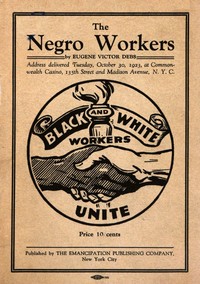
Eugene V. Debs delivered this address on October 30, 1923, at Commonwealth Casino in Harlem, under the auspices of the 21st A.D. Socialist Party of New York. The printed text preserves the full program: preliminary speakers included James Oneal, A. Phillip Randolph, and Lucille Randolph, with Frank R. Crosswaith as chairman. Crosswaith’s introduction frames Debs as a figure in the lineage of John Brown, Frederick Douglass, and Sojourner Truth—a rhetorical move that immediately situates the speech within a tradition of radical abolitionism. Debs himself opens by acknowledging that legacy, stating he is “on the colored man’s side” against those who would keep him in servitude.
The Setting and the Speaker
The address’s paratexts—the title page, introduction, and program—reveal a carefully staged event. Crosswaith’s introduction emphasizes the “segregated section of New York City” where the meeting took place, underscoring the racial geography of 1920s Harlem. Debs’s own remarks reference local concerns: a housing law expiring in February, and a visit from “a delegation of policemen and City firemen” who came on a “perfectly friendly mission.” These details root the speech in a specific time and place, making it as much a campaign rally as a philosophical lecture. The chairman’s hyperbolic praise of Debs’s “precious tenderness” and “sweet and inspiring personality” sets a tone of veneration that the speaker himself undercuts with self-deprecating humor about police visits.
John Brown as a Rhetorical Anchor
Debs repeatedly invokes John Brown as the central historical touchstone. He describes Brown’s “immortal blow” against chattel slavery and quotes Victor Hugo’s protest that “the time will come when you Americans will realize that your John Brown was a greater liberator than your George Washington.” This is not a casual reference; Debs dwells on the paradox that some enslaved people, “so subservient to the masters in their ignorance,” begged to kill Brown while he was in prison. The anecdote serves to illustrate the psychological damage of slavery, a theme Debs extends to his own era. He contrasts Brown’s solitary heroism with the “self-appointed custodians of American liberty” in the Ku Klux Klan, whom he dismisses as a passing force.
Race, Class, and the Socialist Appeal
Debs frames racial oppression as inseparable from class exploitation. He argues that the Ku Klux Klan is a tool of “that cruel and relentless power” that organized after the Civil War and is now reviving. His solution is not racial separatism but working-class unity: he calls for a “campaign of education and organization” that allows Black workers to “register your protest against capitalist corruption and misrule.” The speech’s title, “The Negro Workers,” signals that its primary audience is Black laborers, but Debs insists that their interests align with those of all workers. He points to housing as a concrete issue where “the workers are especially concerned” and where the Socialist Party stands for curbing “capitalistic greed.”
Structure and Orality in the Printed Text
The surviving text is a transcript of a spoken address, and its structure reflects that origin. Debs moves from historical tribute to local politics to a broader socialist critique, punctuated by audience applause noted in parentheses. The prose is colloquial and direct: “I am on the colored man’s side as against all those that are attempting to keep him in servitude.” He uses repetition for emphasis, as when he says “I honor and appreciate all those who stood forth” before pivoting to his own role. The printed version includes the chairman’s introduction and the names of preliminary speakers, preserving the event’s collaborative nature. Readers should note that the text breaks off mid-sentence near the end, leaving Debs’s concluding remarks incomplete.
Because the excerpts are partial—the text cuts off before Debs finishes—readers should approach the address as a fragment of a live performance. The surviving portions, however, offer a clear picture of his rhetorical strategy: grounding a socialist appeal in the specific history of Black resistance, from John Brown to the present. Pay attention to how Debs moves between national symbols (Lincoln, the Klan) and local grievances (housing, police presence), and consider how the printed text’s stage directions—applause, introductions—shape the reading experience.
I keep thinking about that Debs speech—how raw it felt, him standing there urging Black workers to see past what divides us, even naming John Brown and the Klan in the same breath. It reminded me of something quieter but just as persistent: The Paston Letters, A.D. 1422-1509. Volume 6 (of 6), Part 1 (Letters, Chronological Table) New Complete Library Edition — Inside the Classic—ordinary people, centuries apart, still trying to hold their ground and each other.