About 575 minutes
The Works of Lord Byron: Letters and Journals. Vol. 1 — A Closer Reading
Fantasy Juvenile Worlds
132,054 recorded words. 96 minutes difference from this book's estimate.
View Gutenberg source #8901
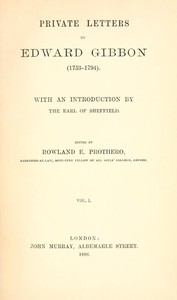
Before opening Private Letters of Edward Gibbon (1753-1794) Volume 1 (of 2) — Background and Themes, the edition data offers a quick orientation: 154,287 words, 11 hr 11 min estimated reading time, and 25 detected text sections.
The text analysis averages about 17.8 words per sentence, while the detected sections provide another way to judge how the source is divided.
Project Gutenberg metadata also associates the work with “Great Britain -- Intellectual life -- 18th century,” connecting these edition facts with the source record’s subject description.
Explore this collection
These alternatives are selected using recorded categories and estimated reading time.
About 575 minutes
Fantasy Juvenile Worlds
132,054 recorded words. 96 minutes difference from this book's estimate.
View Gutenberg source #8901About 561 minutes
Fantasy Juvenile Worlds
128,975 recorded words. 110 minutes difference from this book's estimate.
View Gutenberg source #27153About 811 minutes
Fantasy Juvenile Worlds
186,459 recorded words. 140 minutes difference from this book's estimate.
View Gutenberg source #20755Search stored excerpts and compare books → Choose by your preferences →
Choices use stored catalog measurements. Estimates vary with reading speed. A shared category is a catalog label, not a claim that two books have the same argument or literary quality.
Search reads excerpt text stored with this catalog and links to its associated Gutenberg record. The connection is stored in the site database; this tool does not recheck that every excerpt is word-for-word identical to that external record. Excerpt search does not cover every chapter and does not verify historical publication dates.
Catalog snapshot checked: 2026-09-25. Coverage: 91 public books, 91 available source excerpts.
Read the complete public-domain text at its original source.
Read on Project GutenbergThe letters in this volume open a direct line to Edward Gibbon’s private voice, distinct from the measured cadences of his historical prose. Written to his stepmother, his friend John Holroyd, and others, they show a man who shifts abruptly from discussing American colonial policy to the cost of a book, from grief over a friend’s death to a chess party. The editor, Rowland E. Prothero, and the Earl of Sheffield’s introduction frame these documents as a literary and biographical resource, but the letters themselves resist neat packaging: they are hurried, allusive, and full of the small, unguarded details that formal memoirs omit.
Gibbon’s letters move at the pace of his life. In a single note to Holroyd, he reports being “deep in America” with a Mr. Maudit, then pivots to a Spanish romance he dismisses as “a Romance mixed up with gross improbabilities and anachronisms.” The sentences are short, sometimes fragmentary: “Adieu. Young Cooke of Turin dined with me to-day.” He writes from Bentinck Street, from Twickenham, from the house of a widow he plans to visit. The letters are not essays; they are dispatches, written in the margins of a busy existence. Gibbon’s voice here is less the historian than the man of affairs—impatient, shrewd, and occasionally wry. He notes that a book is “not worth the 18 pence he gave for it,” and he signs off with a joke about men retreating when young ladies advance. These are the rhythms of a mind in motion, not yet settled into the monumental periods of the Decline and Fall.
Several letters are taken up with practical matters: the negotiation of tithes, the execution of a friend’s will, the management of a household. Gibbon writes to his stepmother about the death of “my poor friend” Godfrey Clarke, noting that the shock and “the hurry of melancholy business” have swallowed up lesser concerns. Yet even in grief, he remembers to excuse a delayed payment. The letters are full of such small transactions—a dinner invitation, a request for news, a remark about the weather. They reveal a man embedded in the networks of patronage, friendship, and obligation that structured eighteenth-century life. The editor’s notes supply context for names like Maudit, Hutchinson, and Cooke, but the letters themselves convey the texture of Gibbon’s world: the visits, the committees, the chess games that fill the hours between political crises.
The letters are uneven in length and intensity. Some run to several paragraphs; others are brief notes, dashed off between engagements. Gibbon’s prose quickens when he is excited or annoyed. He writes of the American Congress with evident engagement, but he also complains of a “bad kind of small-pox” in his house and of a guest who outstays his welcome. The shifts in tone are abrupt: from the formal address “Dear Madam” to the casual “Adieu. I write with severall people in the room.” This variability is not carelessness but a reflection of the circumstances of composition. The letters were not written for publication, and their unevenness is part of their value. They show a man who could be both the cool analyst of empires and the irritable householder, and who moved between these roles without warning.
Readers approaching these letters should expect to piece together context from the editor’s notes and from the sequence of dates. The letters do not form a continuous narrative; they are a series of glimpses. Pay attention to what Gibbon leaves out as much as to what he includes. The gaps—the silences between letters, the references to events he assumes his correspondent knows—are where the real story lies. This is not a polished autobiography but a record of a life as it was lived, in fragments and interruptions.
That rainy afternoon, I lost myself in Gibbon’s private letters, his dry wit echoing through centuries of London fog. What struck me most was how fiercely he defended his aesthetic judgments against friends’ doubts. That same stubborn, brittle passion for art surfaced later, almost unbidden, when I picked up Wilde v Whistler Being an Acrimonious Correspondence on Art Between Oscar Wilde and James A McNeill Whistler — Background and Themes. Two eras, same delightful indignation over beauty.
Build a private reading journal entry for this title.