About 21 minutes
How it feels to be colored me — Context and Discussion
Fantasy Juvenile Worlds
4,731 recorded words. 6 minutes difference from this book's estimate.
View Gutenberg source #73549
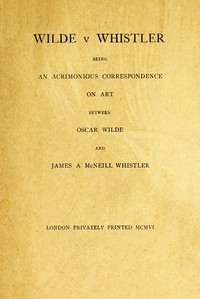
The catalog record for Wilde v Whistler Being an Acrimonious Correspondence on Art Between Oscar Wilde and James A McNeill Whistler — Background and Themes provides practical reading context through 6,061 words, 27 min estimated reading time, and 13 detected text sections.
The text analysis averages about 25.1 words per sentence, while the detected sections provide another way to judge how the source is divided.
Project Gutenberg metadata also associates the work with “Wilde, Oscar, 1854-1900 -- Correspondence,” connecting these edition facts with the source record’s subject description.
Explore this collection
These alternatives are selected using recorded categories and estimated reading time.
About 21 minutes
Fantasy Juvenile Worlds
4,731 recorded words. 6 minutes difference from this book's estimate.
View Gutenberg source #73549About 69 minutes
Fantasy Juvenile Worlds
15,661 recorded words. 42 minutes difference from this book's estimate.
View Gutenberg source #33241About 86 minutes
Fantasy Juvenile Worlds
19,660 recorded words. 59 minutes difference from this book's estimate.
View Gutenberg source #17548Search stored excerpts and compare books → Choose by your preferences →
Choices use stored catalog measurements. Estimates vary with reading speed. A shared category is a catalog label, not a claim that two books have the same argument or literary quality.
Search reads excerpt text stored with this catalog and links to its associated Gutenberg record. The connection is stored in the site database; this tool does not recheck that every excerpt is word-for-word identical to that external record. Excerpt search does not cover every chapter and does not verify historical publication dates.
Catalog snapshot checked: 2026-09-25. Coverage: 91 public books, 91 available source excerpts.
Read the complete public-domain text at its original source.
Read on Project GutenbergThe volume opens with Wilde’s review of Whistler’s “Ten O’Clock” lecture, published in the Pall Mall Gazette on February 21, 1885. Wilde immediately sets a tone of ironic admiration, describing Whistler’s “really marvellous eloquence on the absolute uselessness of all lectures of the kind.” The review portrays Whistler as a “miniature Mephistopheles mocking the majority,” a phrase that captures the combative theatricality of both men. This initial piece establishes the central tension: a public debate about art’s purpose, conducted through witty, venomous prose.
Wilde’s review is not a neutral report but a performance in itself. He paraphrases Whistler’s argument—that the public should cultivate ugliness—while subtly mocking the audience’s discomfort. The description of Whistler as “a brilliant surgeon lecturing to a class composed of subjects destined ultimately for dissection” turns the lecture into a theatrical spectacle. Wilde’s own voice emerges through elaborate metaphors and a tone of amused condescension. The review ends with a pointed remark about the audience’s “permanent stupidity,” a jab that foreshadows the personal animosity to come. Readers should note how Wilde uses Whistler’s own rhetorical strategies against him, a pattern that recurs throughout the correspondence.
Whistler responds with escalating accusations, claiming Wilde has stolen his ideas. In one letter, he refers to Wilde’s “lucubrations” and calls him an “ill-bred and ignorant person.” The charge of plagiarism becomes a recurring motif: Whistler accuses Wilde of appropriating material from his lecture for Wilde’s article “The Decay of Lying” in the Nineteenth Century Review (January 1889). Whistler’s tone shifts from sarcastic to indignant, as he demands that Wilde “restore those things to Nathan’s” and stop “masquerading the streets of my Chelsea.” These exchanges reveal a deep personal rivalry, where artistic disagreements are inseparable from social status and public reputation.
Wilde’s replies are fewer in the excerpts, but his defensive strategy is clear. He adopts a tone of wounded innocence, claiming that Whistler’s attacks are “impertinent, venomous, and vulgar.” Yet he also subtly undermines Whistler by referring to him as “my master,” a sarcastic acknowledgment of Whistler’s claim to influence. The correspondence is mediated through newspapers and private letters, making the press a third party in the dispute. Readers should observe how each writer tailors his language for a public audience, using hyperbole and theatrical insults to entertain as much as to argue. The excerpts suggest that the feud is as much about performance as about principles.
The later excerpts escalate into direct personal attacks. Whistler’s note “JUST INDIGNATION” mocks Wilde’s appearance in a “Polish cap and green overcoat, befrogged, and wonderfully befurred,” a vivid image that reduces the debate to caricature. Whistler’s closing line—“the rage of the sheep is terrible”—dismisses Wilde’s supporters as a mindless herd. The correspondence ends without resolution, leaving the reader with a sense of unresolved bitterness. The transcriber’s note indicates that punctuation and spelling have been silently corrected, but the raw energy of the original exchanges remains. This final section underscores how the feud devolves from intellectual debate to personal ridicule, a trajectory that defines the entire collection.
This collection offers a concentrated glimpse into a famous artistic rivalry, but the excerpts are incomplete. Readers should not assume they capture the full arc of the dispute or the broader context of the “art for art’s sake” movement. The letters and reviews are best read as performances, where each writer crafts a persona through language. Pay attention to the shifting tones—from Wilde’s ironic elegance to Whistler’s blistering sarcasm—and consider how the public nature of the exchange shapes each argument. The volume is a document of its time, revealing how late-Victorian artists used the press to wage personal and aesthetic battles.
Reading their sniping at each other, I remembered passing notes with a friend who’d become a stranger, each joke curling into a dig. Those letters felt heavy the same way—paper caught between loyalty and distance. Letters from the peninsula, 1808-1812 — Reading Notes brought that ache back: how war letters hold more unsaid than said. I kept thinking how we archive arguments but rarely their silences.
Your answers remain private and are stored only in this browser.