About 280 minutes
Birds and Poets : with Other Papers — Inside the Classic
Science Fiction Utopias
64,225 recorded words. 58 minutes difference from this book's estimate.
View Gutenberg source #5177
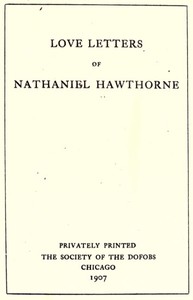
This digital edition of Love Letters of Nathaniel Hawthorne, Volume 1 (of 2) — Text and Context is described by source-level measurements including 50,873 words, 3 hr 42 min estimated reading time, and 5 detected text sections.
The text analysis averages about 21.3 words per sentence, while the detected sections provide another way to judge how the source is divided.
Project Gutenberg metadata also associates the work with “Love-letters,” connecting these edition facts with the source record’s subject description.
Explore this collection
These alternatives are selected using recorded categories and estimated reading time.
About 280 minutes
Science Fiction Utopias
64,225 recorded words. 58 minutes difference from this book's estimate.
View Gutenberg source #5177About 302 minutes
Science Fiction Utopias
69,355 recorded words. 80 minutes difference from this book's estimate.
View Gutenberg source #75294About 137 minutes
Science Fiction Utopias
31,493 recorded words. 85 minutes difference from this book's estimate.
View Gutenberg source #25012Search stored excerpts and compare books → Choose by your preferences →
Choices use stored catalog measurements. Estimates vary with reading speed. A shared category is a catalog label, not a claim that two books have the same argument or literary quality.
Search reads excerpt text stored with this catalog and links to its associated Gutenberg record. The connection is stored in the site database; this tool does not recheck that every excerpt is word-for-word identical to that external record. Excerpt search does not cover every chapter and does not verify historical publication dates.
Catalog snapshot checked: 2026-09-25. Coverage: 91 public books, 91 available source excerpts.
Read the complete public-domain text at its original source.
Read on Project GutenbergThese letters, written between 1839 and 1842, capture Nathaniel Hawthorne's courtship of Sophia Peabody with a directness absent from his fiction. Unlike the allegorical reserve of his tales, here Hawthorne addresses his "Ownest Dove" with playful endearments and precise domestic details. The correspondence was privately printed in 1907 by the Society of the Dofobs, with the stated aim of preserving continuity and avoiding violations of confidence. The editors noted that little required elision, as the letters stayed within "innocent limits of good-natured banter."
What emerges is a portrait of a writer deeply engaged in the material world: he describes unpacking Sophia's paintings with trembling hands, arranging them on his mantelpiece, and debating whether to kiss the depicted figure. The letters also document his work as a measurer at the Boston Custom House, where coal vessels and absent colleagues delayed his visits to Salem.
In the letter of January 24, 1840, Hawthorne describes receiving a package of pictures from Sophia. His response is remarkably tactile and theatrical: he "trembled" while undoing it, then sat "with clasped hands, gazing, and gazing, and gazing." He identifies a dove in the painting "Menaggio" as Sophia herself, and imagines kissing the figure of "naughty Sophie Hawthorne" on the bridge—though he refrains, fearing she might vanish. This blend of reverence and playful threat recurs throughout the volume.
Hawthorne treats the paintings as living presences. He insists that the male figure in the scene must be himself, because the dove (Sophia's emblem) would not alight on another hand. He plans to lock the pictures away when absent, fearing dust and chambermaids. The letters thus become a record of how an author known for symbolic romance applied that same imaginative intensity to his beloved's art.
Hawthorne's letters frequently mention the practical obstacles to his visits. In the same January letter, he explains that two measurers are employed, another is detained by family sickness, and Colonel Hall remains too unwell to attend the Custom House. He himself has a coal vessel to discharge. These details ground the romance in the mundane rhythms of 1840s Boston harbor work.
The letters show Hawthorne navigating between bureaucratic duty and personal longing. He promises to come "by Tuesday or Wednesday at furthest," but the schedule remains uncertain. This tension between the prosaic and the passionate is a recurring structural feature: declarations of eternal love sit alongside reports of cargo inspections. The reader sees a writer who, even while measuring coal, composes sentences of considerable tenderness.
The introductory note explains that previous publications by Julian Hawthorne and Rose Hawthorne Lathrop had excerpted these letters "free and irregular," often running passages together to illustrate character. The present edition aims to restore continuity and convey "the simplicity, beauty, humor and tenderness" of the originals. However, the editors acknowledge that some letters may have been lost or withheld, and that the surviving set is not the complete correspondence.
Readers should note that the catalog subjects classify this work under "Science Fiction & Utopias," a category that bears no relation to the actual content. The letters are intimate, personal documents, not speculative fiction. The metadata also lists Hawthorne as the sole author, though the volume includes his voice alone; Sophia's replies are absent. This asymmetry shapes every page: we hear only one side of the dialogue, filtered through Hawthorne's characteristic self-deprecation and ardor.
The volume offers a rare view of Hawthorne's private idiom—his pet names, his anxieties about health (he urges Sophia to "grow round and plump and rosy"), and his habit of projecting symbolic meanings onto everyday objects. Because the letters are presented in sequence, the reader can trace the evolution of his tone across months. The absence of Sophia's responses leaves gaps, but Hawthorne's voice is vivid enough to suggest the shape of their shared world. Approach these letters as a performance of intimacy, not a transparent record.
There’s something tender in watching Hawthorne fuss over Sophia’s letters—how he measures his days around her words, same as I once did. It made me think of Gibbon, all those years alone with his Decline and Fall, pouring himself into pages meant for no one. Private Letters of Edward Gibbon (1753-1794) Volume 2 (of 2) — Story, Setting & Ideas holds that same quiet ache—great minds, writing to stay near someone.
Save your reaction, strongest insight, and memorable passage.