About 280 minutes
Birds and Poets : with Other Papers — Inside the Classic
Science Fiction Utopias
64,225 recorded words. 22 minutes difference from this book's estimate.
View Gutenberg source #5177
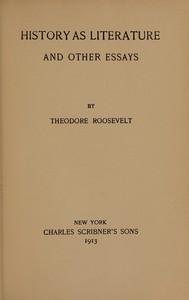
Before opening History as literature, and other essays — Key Ideas to Explore, the edition data offers a quick orientation: 69,355 words, 5 hr 2 min estimated reading time, and 16 detected text sections.
The text analysis averages about 32.4 words per sentence, while the detected sections provide another way to judge how the source is divided.
Project Gutenberg metadata also associates the work with “History -- Philosophy,” connecting these edition facts with the source record’s subject description.
Explore this collection
These alternatives are selected using recorded categories and estimated reading time.
About 280 minutes
Science Fiction Utopias
64,225 recorded words. 22 minutes difference from this book's estimate.
View Gutenberg source #5177About 365 minutes
Science Fiction Utopias
83,851 recorded words. 63 minutes difference from this book's estimate.
View Gutenberg source #2653About 222 minutes
Science Fiction Utopias
50,873 recorded words. 80 minutes difference from this book's estimate.
View Gutenberg source #41309Search stored excerpts and compare books → Choose by your preferences →
Choices use stored catalog measurements. Estimates vary with reading speed. A shared category is a catalog label, not a claim that two books have the same argument or literary quality.
Search reads excerpt text stored with this catalog and links to its associated Gutenberg record. The connection is stored in the site database; this tool does not recheck that every excerpt is word-for-word identical to that external record. Excerpt search does not cover every chapter and does not verify historical publication dates.
Catalog snapshot checked: 2026-09-25. Coverage: 91 public books, 91 available source excerpts.
Read the complete public-domain text at its original source.
Read on Project GutenbergThe opening address, delivered as president of the American Historical Association in 1912, directly confronts the question of whether history should be treated as a branch of science or of literature. Roosevelt dismisses much of the dispute as terminological, but insists that when science claims exclusive possession of the field, there is a real basis for conflict. He traces a time when history was distinguished neither from poetry nor mythology, and argues that the historian must possess both the qualities that make for efficiency and those that direct efficiency toward the public good.
This framing sets the collection's central thesis: the domain of literature must be extended over history and science. The preface notes that the addresses were given at Oxford, Berlin, and the Sorbonne, and the essays originally appeared in The Outlook and The Century. Readers should expect a blend of literary criticism, historical argument, and civic exhortation.
The title essay, “History as Literature,” opens with a declaration that the dispute over history’s classification is partly terminological. Roosevelt does not deny the need for scientific method—accuracy, evidence, verification—but insists that history without literary form fails to reach its audience. He evokes the “marvellous dawn of Hellenic life” when history, poetry, and mythology were not yet separate. The historian, he implies, must be both a rigorous researcher and a skilled writer.
Roosevelt’s own prose in this essay is direct and argumentative, with short, emphatic sentences. He uses contrasts: “There is little place in active life for the timid good man” versus the man whose efficiency is not guided by moral sense. The reader should note how he balances technical historical discussion with rhetorical force, embodying the very union he advocates.
The excerpt from “Citizenship in a Republic” shifts from historiography to civic duty. Roosevelt argues that the good citizen must first be able to hold his own—he must be efficient, hardworking, and ready to fight. But efficiency without moral sense makes a man more dangerous. He condemns judging a man merely by success, calling it “an abhorrent wrong.”
The language is blunt and aphoristic: “Virtue which is dependent upon a sluggish circulation is not impressive.” Roosevelt warns against the “closet philosopher” and the “impracticable visionary,” favoring the reformer who achieves practical results. This section reveals his belief that character, not intellect alone, underpins free institutions. The homely virtues of household and workaday life stand at the bottom of character, but duties to the state must be added.
The table of contents shows the collection’s breadth: “Biological Analogies in History,” “The World Movement,” “Dante and the Bowery,” “The Ancient Irish Sagas,” and “An Art Exhibition.” Roosevelt addressed the University of Oxford, the University of Berlin, and the Sorbonne, as well as the American Historical Association. The essays originally appeared in popular periodicals, suggesting he aimed at a general educated readership, not specialists alone.
Three chapters were previously included in African and European Addresses, indicating some overlap with his earlier work. The preface states that he discusses “not merely literary but also historical and scientific subjects,” and his thesis is consistent: literature’s domain must expand. Readers encountering the collection for the first time should note how each piece applies the central argument to a different field—biology, national sagas, art criticism—testing its versatility.
Throughout the excerpts, Roosevelt employs a distinctive rhetorical pattern: he sets up a dichotomy, dismisses false oppositions, and then asserts a synthesis. In the history-as-literature debate, he rejects the exclusive claims of science while accepting its tools. In the citizenship essay, he balances efficiency and moral sense, warning against both the timid good man and the ruthless efficient man.
His sentences are often short and declarative, with parallel structures: “He is useless if he is inefficient. … Virtue which is dependent upon a sluggish circulation is not impressive.” He uses concrete examples—money-maker, politician, soldier, orator—to ground abstract principles. The reader should watch for how he moves from general principle to specific application, a method that makes his arguments accessible even when the subject is academic.
This collection rewards readers who approach it as a series of performances: each address or essay was delivered to a specific audience, and Roosevelt adapts his tone accordingly—more academic before historians, more exhortatory before citizens. The excerpts show a writer who believed that ideas must be communicated with force and clarity. A first reading might focus on the opening essay to grasp the core argument, then sample the later pieces to see how it plays out in different contexts.
There’s a comfort in old voices that insist truth can be told beautifully, not just accurately. Roosevelt’s essays made me think of that quiet ache for stories grounded in real ground. It reminded me of something gentler, too, The Backwoods of Canada Being Letters from the Wife of an Emigrant Officer, Illustrative of the Domestic Economy of British America — Story, Setting & Ideas — a woman’s letters turning daily survival into something close to poetry. Both linger, somehow.
Save your reaction, strongest insight, and memorable passage.