About 773 minutes
The Works of Lord Byron: Letters and Journals. Vol. 2 — Text and Context
Science Fiction Utopias
177,648 recorded words. 5 minutes difference from this book's estimate.
View Gutenberg source #9921
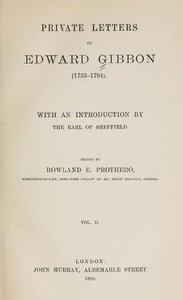
This digital edition of Private Letters of Edward Gibbon (1753-1794) Volume 2 (of 2) — Story, Setting & Ideas is described by source-level measurements including 176,451 words, 12 hr 48 min estimated reading time, and 30 detected text sections.
The text analysis averages about 16.8 words per sentence, while the detected sections provide another way to judge how the source is divided.
Project Gutenberg metadata also associates the work with “Great Britain -- Intellectual life -- 18th century,” connecting these edition facts with the source record’s subject description.
Explore this collection
These alternatives are selected using recorded categories and estimated reading time.
About 773 minutes
Science Fiction Utopias
177,648 recorded words. 5 minutes difference from this book's estimate.
View Gutenberg source #9921About 791 minutes
Science Fiction Utopias
181,767 recorded words. 23 minutes difference from this book's estimate.
View Gutenberg source #45463About 726 minutes
Science Fiction Utopias
166,828 recorded words. 42 minutes difference from this book's estimate.
View Gutenberg source #3286Search stored excerpts and compare books → Choose by your preferences →
Choices use stored catalog measurements. Estimates vary with reading speed. A shared category is a catalog label, not a claim that two books have the same argument or literary quality.
Search reads excerpt text stored with this catalog and links to its associated Gutenberg record. The connection is stored in the site database; this tool does not recheck that every excerpt is word-for-word identical to that external record. Excerpt search does not cover every chapter and does not verify historical publication dates.
Catalog snapshot checked: 2026-09-25. Coverage: 91 public books, 91 available source excerpts.
Read the complete public-domain text at its original source.
Read on Project GutenbergThe second volume of Edward Gibbon's private correspondence opens in 1781 with the historian newly seated in Parliament, writing to his stepmother about the tedium of sessions and the hire of a country house at Brighthelmstone. His tone is urbane, self-mocking, and concerned with domestic arrangements—he promises not to bathe without advice. A decade later, the letters are dominated by the flight and arrest of Louis XVI. Lord Sheffield's dispatches from Paris, dated July 1791, report on the King's recapture, the mood of the National Assembly, and the risk of travel. The shift from Gibbon's measured irony to Sheffield's breathless, detail-laden prose marks a change in pace as the Revolution overtakes private life.
The earliest letters in this volume treat politics as a backdrop to personal routine. Gibbon reports his election to Lymington as a formality—'my new constituents obligingly chose me in my absence'—and complains of 'the heat and length of the Session' with the detachment of a clubman. His stepmother receives reassurances about his health and his summer plans: a hired house, light study, good company. By 1791, the correspondence is overtaken by events. Lord Sheffield writes from Paris during the crisis following the King's flight to Varennes. His letters are packed with intelligence: 'the Royal animal is again caught,' he writes; 'they are determined to get rid of the King, but how, is not so easy a business.' The pace accelerates from Gibbon's measured paragraphs to Sheffield's urgent, fragmentary sentences, reflecting a world where private letters become news bulletins.
Even in personal letters, Gibbon's prose carries the cadence of his historical writing. He describes Lady Miller's sudden death as having 'excited some attention even in this busy World'—a phrase that could belong to the Decline and Fall. His advice to his stepmother not to let Mrs. Ravaud 'tempt you into Elysium' is a playful classical allusion. Yet the voice is not uniform. When Sheffield takes over the narrative, the style shifts: his sentences are shorter, more direct, and filled with proper names—Cazalès, La Fayette, De Bouillé—and practical concerns about passports and routes. The contrast between Gibbon's ironic detachment and Sheffield's engaged reportage highlights how the Revolution disrupted not only politics but the very manner of private correspondence.
Amid the crisis, the letters retain a vivid sense of material life. Gibbon hires a house at Brighthelmstone for three months; Sheffield dines at the Castle of Navarre with the Duke of Bouillon and attends the Comédie Française. The practicalities of travel—'the best and shortest road, instead of Besançon, is by Dijon, Dole, Les Rousses, and Nyon'—are set against the uncertainty of whether the King will be allowed to leave France. Sheffield notes that 'the Judges agree that the Gardes de Corps cannot be tried' and that the Queen 'will be allowed to go if she pleases.' These details, embedded in letters meant for a single reader, offer a granular view of how the Revolution was experienced by those moving between countries. The larder must be furnished for an uncertain arrival; tea is the appointed hour.
Rowland E. Prothero's edition arranges the letters chronologically, with an introduction by the Earl of Sheffield. The volume covers the final thirteen years of Gibbon's life, from his parliamentary service to his death in Lausanne. The excerpts show that the collection is not a continuous narrative but a series of snapshots, with gaps that the reader must infer. The editor's presence is minimal in the text itself, allowing the correspondents' voices to dominate. The shift from Gibbon's own letters to those of his correspondents—particularly Lord Sheffield—creates a polyphonic effect, where the historian's measured tone is answered by the urgent, news-driven prose of a friend caught in revolutionary Paris. This editorial choice foregrounds the change in pace that the Revolution imposed on private life.
Readers approaching this volume should attend to the interplay between Gibbon's characteristic irony and the raw immediacy of Sheffield's reports. The letters are best read not as a continuous autobiography but as a series of dispatches from a historian whose world was being remade. The gaps between letters—the silences—are as telling as the words. For those interested in the texture of eighteenth-century correspondence, this collection offers a rare view of how private writing adapted to public crisis, without losing its personal intimacy.
Reading Gibbon’s letters from the revolutionary years, I felt the quiet ache of a mind watching its world shift beneath it. It made me recall the gentler melancholy in the Prose remains of Arthur Hugh Clough, with a selection from his letters and a memoir — Background and Themes, where doubt lingers softly, unspoken. Both voices carry that same hesitant pause—a pause before trusting what comes next.
Your answers remain private and are stored only in this browser.