About 137 minutes
The Case of Wagner, Nietzsche Contra Wagner, and Selected Aphorisms. — Inside the Classic
Science Fiction Utopias
31,493 recorded words. 26 minutes difference from this book's estimate.
View Gutenberg source #25012
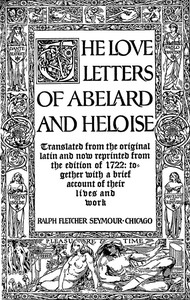
The source record for The love letters of Abelard and Heloise — Key Ideas to Explore measures this digital text at 25,498 words, 1 hr 51 min estimated reading time, and 3 detected text sections.
The text analysis averages about 22.1 words per sentence, while the detected sections provide another way to judge how the source is divided.
Project Gutenberg metadata also associates the work with “Love-letters,” connecting these edition facts with the source record’s subject description.
Explore this collection
These alternatives are selected using recorded categories and estimated reading time.
About 137 minutes
Science Fiction Utopias
31,493 recorded words. 26 minutes difference from this book's estimate.
View Gutenberg source #25012About 38 minutes
Science Fiction Utopias
8,722 recorded words. 73 minutes difference from this book's estimate.
View Gutenberg source #32155About 33 minutes
Science Fiction Utopias
7,570 recorded words. 78 minutes difference from this book's estimate.
View Gutenberg source #68309Search stored excerpts and compare books → Choose by your preferences →
Choices use stored catalog measurements. Estimates vary with reading speed. A shared category is a catalog label, not a claim that two books have the same argument or literary quality.
Search reads excerpt text stored with this catalog and links to its associated Gutenberg record. The connection is stored in the site database; this tool does not recheck that every excerpt is word-for-word identical to that external record. Excerpt search does not cover every chapter and does not verify historical publication dates.
Catalog snapshot checked: 2026-09-25. Coverage: 91 public books, 91 available source excerpts.
Read the complete public-domain text at its original source.
Read on Project GutenbergThis edition of the love letters of Abelard and Heloise, translated from the Latin and reprinted from the 1722 edition, opens not with the correspondence itself but with a narrative account of their story. The anonymous translator frames the lovers as figures whose personal tragedy has been "crowned with the violet crown of Grecian Sappho," a classical allusion that sets an elevated, almost mythologizing tone. The prefatory section describes their meeting "among the stone-walled, rose-covered gardens" near Notre Dame, a setting rendered in deliberately picturesque language that contrasts sharply with the raw emotional intensity of the letters that follow.
The editorial preface, likely written by the translator or publisher, does more than summarize events. It introduces Abelard as "gifted and ambitious" and Heloise as "the beautiful maiden," casting their relationship as a romance of intellectual and emotional awakening. The prose is measured and descriptive, with phrases like "Time, swift and silent as the Seine, sped on" creating a lyrical distance. This voice stands apart from the letters themselves, where Heloise’s language becomes urgent and fragmented. The shift from third-person narration to first-person epistolary outpouring marks a deliberate change in pace and intimacy. Readers moving from the preface to the first letter will notice a sudden compression of time and a leap into direct, unmediated emotion.
In her letter responding to Abelard’s fears of death, Heloise’s language accelerates into a series of exclamations and rhetorical questions: "Cruel Abelard! you ought to have stopped my tears and you make them flow." The repetition of "you ought" and the direct address create a rhythm of accusation and plea. She invokes Seneca to argue against anticipating future sorrows, yet her own prose is consumed by the very fear she condemns. The sentence "Life without Abelard were an insupportable punishment" uses the subjunctive to project a hypothetical future that feels immediate. Her voice oscillates between logical argument and emotional collapse, a tension that drives the letter forward. The pace is breathless, with clauses piling up as she imagines his death and her own inability to pray or find peace.
Heloise’s response to Abelard’s request that his body be brought to the Paraclete reveals a preoccupation with physical presence and memory. She asks, "Can you think that the traces you have drawn on my heart can ever be worn out?" Here, the heart is both a literal organ and a metaphorical surface inscribed by experience. The image of traces that cannot be erased suggests a permanence that contradicts the fragility of the body. Later, she describes her anticipated grief as a state where she would be "distracted and raving" against Heaven itself, unable to perform the prayers he expects. This passage ties the physical act of mourning—the funeral, the prayers—to an inner turmoil that renders ritual meaningless. The body, whether his corpse or her living frame, becomes the focal point of a struggle between duty and overwhelming sorrow.
Readers approaching this edition should attend to the contrast between the measured biographical frame and the volatile voice of Heloise’s letters. The preface offers a romanticized backdrop, but the correspondence itself resists such easy framing. Pay particular attention to how Heloise’s syntax breaks down under emotional pressure, and how she uses classical references not as ornament but as weapons in an argument against despair. The letters reward close reading for their rhetorical structure as much as their historical interest.
That editorial voice in Abelard and Heloise—how it shifts from quiet biography into something raw and intimate—stayed with me long after. It reminded me of sitting with old letters, hearing someone’s breath between the lines. There’s a similar stillness in Cicero: Letters to Atticus, Vol. 3 of 3 — Story, Setting & Ideas, where friendship becomes a kind of quiet anchor against the world’s noise. I keep thinking about that.
Build a private reading journal entry for this title.