About 38 minutes
The Love Letters of Henry VIII to Anne Boleyn; With Notes — A Closer Reading
Science Fiction Utopias
8,722 recorded words. 5 minutes difference from this book's estimate.
View Gutenberg source #32155
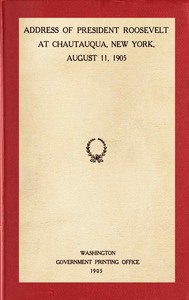
The source record for Address of President Roosevelt at Chautauqua, New York, August 11, 1905 — Key Ideas to Explore measures this digital text at 7,570 words, 33 min estimated reading time, and 3 detected text sections.
The text analysis averages about 32.6 words per sentence, while the detected sections provide another way to judge how the source is divided.
Project Gutenberg metadata also associates the work with “Speeches, addresses, etc.,” connecting these edition facts with the source record’s subject description.
Explore this collection
These alternatives are selected using recorded categories and estimated reading time.
About 38 minutes
Science Fiction Utopias
8,722 recorded words. 5 minutes difference from this book's estimate.
View Gutenberg source #32155About 111 minutes
Science Fiction Utopias
25,498 recorded words. 78 minutes difference from this book's estimate.
View Gutenberg source #40227About 137 minutes
Science Fiction Utopias
31,493 recorded words. 104 minutes difference from this book's estimate.
View Gutenberg source #25012Search stored excerpts and compare books → Choose by your preferences →
Choices use stored catalog measurements. Estimates vary with reading speed. A shared category is a catalog label, not a claim that two books have the same argument or literary quality.
Search reads excerpt text stored with this catalog and links to its associated Gutenberg record. The connection is stored in the site database; this tool does not recheck that every excerpt is word-for-word identical to that external record. Excerpt search does not cover every chapter and does not verify historical publication dates.
Catalog snapshot checked: 2026-09-25. Coverage: 91 public books, 91 available source excerpts.
Read the complete public-domain text at its original source.
Read on Project GutenbergTheodore Roosevelt's 1905 Chautauqua address opens with a striking structural choice: he announces he will speak on "one feature of our national foreign policy and one feature of our national domestic policy," then devotes roughly half the speech to each. This bipartite design mirrors his central argument that rights and responsibilities are inseparable, whether in international relations or corporate oversight. The speech's movement between these two spheres is not abrupt but gradual, with Roosevelt using recurring images—particularly the contrast between fossilization and growth—to bind them together. He warns that a doctrine, government, or individual that becomes fossilized faces death, a metaphor that reappears in his discussion of corporate regulation, where he insists that laws must adapt to changing conditions. The address thus builds a coherent vision of national power as dynamic and accountable.
Roosevelt frames the Monroe Doctrine not as a fixed rule of international law but as a "fundamental feature" of foreign policy that must evolve. He uses the word "fossilized" twice in quick succession, first to reject a static interpretation, then to assert that "fossilization, of course, means death." This biological metaphor recurs when he speaks of the doctrine's "growing, changing needs" and insists that the United States must accept the "consequences" of its policy, which "from time to time alter." The speech's structure reinforces this adaptability: Roosevelt moves from defining the doctrine (forbidding territorial encroachment by non-American powers) to outlining its dual purpose—protecting the nation and securing "our fellow-republics south of us" the chance to develop without oppression. He then pivots to a concrete example: the Dominican Republic, where the U.S. had recently taken on financial oversight. The shift from abstract principle to specific case mirrors the doctrine's own movement from declaration to application.
A key structural feature of the address is Roosevelt's repeated pairing of rights with obligations. In the foreign policy section, he states flatly: "It is out of the question to claim a right and yet shirk the responsibility for exercising that right." This sentence acts as a hinge, connecting the Monroe Doctrine to the domestic discussion of corporate power. When he turns to antitrust law, he applies the same logic: corporations that enjoy "incalculable" benefits from interstate commerce must submit to federal supervision. Roosevelt builds his case through a series of conditional statements—"we can not permanently adhere to the Monroe Doctrine unless"—and parallel constructions that link foreign and domestic policy. The speech's movement between these realms suggests that the same principle governs both: power, whether national or corporate, must be exercised with accountability. The recurring phrase "we mean" ("we mean what we say," "we mean to recognize our obligations") reinforces this theme of intentional, responsible action.
Roosevelt's imagery draws heavily on organic metaphors of life, death, and growth. The word "fossilized" appears only in the foreign policy section, but its opposite—growth, adaptation, vitality—pervades the entire speech. He speaks of the Monroe Doctrine meeting "with more and more respect" as the nation grows "more and more powerful," a repetition that suggests cumulative strength. In the domestic section, he describes the economy as a system where "interests of all men are so closely intertwined" that prosperity under normal conditions benefits both the "exceptional man" and the average worker. The guiding intelligence of the man at the top is a "vital factor" in production. Yet Roosevelt also warns of decay: when corporations "strain the last resources of legal technicality to avoid obedience," they threaten the health of the system. The speech thus oscillates between images of flourishing and stasis, using this tension to argue for active governance that prevents fossilization in both foreign and domestic affairs.
The address was delivered at the Chautauqua Institution in upstate New York, a setting associated with adult education, moral uplift, and civic discourse. Roosevelt acknowledges this context only implicitly, but the speech's structure—a clear, two-part argument delivered in plain language—reflects the Chautauqua tradition of accessible public lectures. The setting also shapes the speech's movement: Roosevelt begins with a broad statement of purpose, then narrows to specific policies (the Dominican Republic, antitrust legislation), before widening again to general principles about prosperity and fairness. This concentric structure, moving from abstract to concrete and back, suits an audience of educated citizens rather than specialists. The closing paragraphs return to the theme of mutual benefit, urging listeners to recognize that "the interests of all men are so closely intertwined." The Chautauqua platform, a space for reasoned debate and moral instruction, thus becomes a model for the kind of responsible citizenship Roosevelt advocates.
Readers approaching this address will find its bipartite structure more than a convenience: it is the argument made visible. Roosevelt's movement between foreign and domestic policy, and his repeated use of organic metaphors, create a unified vision of national power as something that must be exercised with foresight and restraint. The speech rewards attention to its transitions—how a discussion of the Monroe Doctrine becomes a discussion of corporate law, and how both return to the same principle of responsibility. For those interested in Roosevelt's rhetoric or early twentieth-century political thought, this address offers a compact, carefully constructed example of how a president used a public platform to link disparate policy areas into a coherent philosophy.
I keep thinking about Roosevelt’s speech, how he saw strength as needing accountability, not just power. It lingered like a quiet ache. That same delicate weight lives in The love letters of Abelard and Heloise — Key Ideas to Explore—passion bound by consequence, every choice carrying its own afterimage. It felt less like reading and more like remembering something I hadn’t yet lived.
Your answers remain private and are stored only in this browser.