About 481 minutes
George Eliot's Life, as Related in Her Letters and Journals. Vol. 3 (of 3) — Inside the Classic
Fantasy Juvenile Worlds
110,581 recorded words. 4 minutes difference from this book's estimate.
View Gutenberg source #43045
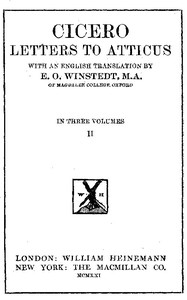
For Cicero: Letters to Atticus, Vol. 2 of 3 — Background and Themes, the stored edition analysis reports 111,536 words, 8 hr 5 min estimated reading time, and 21 detected text sections.
The text analysis averages about 15.1 words per sentence, while the detected sections provide another way to judge how the source is divided.
Project Gutenberg metadata also associates the work with “Latin letters -- Translations into English,” connecting these edition facts with the source record’s subject description.
Explore this collection
These alternatives are selected using recorded categories and estimated reading time.
About 481 minutes
Fantasy Juvenile Worlds
110,581 recorded words. 4 minutes difference from this book's estimate.
View Gutenberg source #43045About 516 minutes
Fantasy Juvenile Worlds
118,493 recorded words. 31 minutes difference from this book's estimate.
View Gutenberg source #45929About 447 minutes
Fantasy Juvenile Worlds
102,593 recorded words. 38 minutes difference from this book's estimate.
View Gutenberg source #15045Search stored excerpts and compare books → Choose by your preferences →
Choices use stored catalog measurements. Estimates vary with reading speed. A shared category is a catalog label, not a claim that two books have the same argument or literary quality.
Search reads excerpt text stored with this catalog and links to its associated Gutenberg record. The connection is stored in the site database; this tool does not recheck that every excerpt is word-for-word identical to that external record. Excerpt search does not cover every chapter and does not verify historical publication dates.
Catalog snapshot checked: 2026-09-25. Coverage: 91 public books, 91 available source excerpts.
Read the complete public-domain text at its original source.
Read on Project GutenbergThe second volume of Cicero's letters to Atticus opens in the midst of a constitutional crisis. The introduction sketches the legal maneuvers that forced Caesar's hand—Pompey's laws on provincial appointments and candidacy—but the letters themselves plunge into the confusion of early 49 BCE. Cicero writes from Formiae on March 18, admitting he has "nothing to write" yet fills the page with self-reproach: "I seem to myself to have been mad from the very beginning." The epistolary form here becomes a diary of indecision, with Cicero berating himself for not following Pompey "like a private soldier."
The first excerpt shows Cicero oscillating between high politics and personal business. He reports a senatorial debate over the legality of proposing Caesar for election in absentia, noting the precedent that "it is illegal for consuls" to be proposed by inferior magistrates. Yet immediately he turns to the purchase of an estate at Lanuvium, haggling over £4,500 and worrying about "the scarcity of money." This juxtaposition is characteristic: Cicero treats political collapse and real estate with the same anxious precision. He warns Atticus of "a wicked war" while simultaneously calculating the depreciation of country seats. The letter closes with a dark aside: "all these seats seem now to be doomed to destruction."
The second excerpt, dated March 18, 49 BCE, is one of the most personal in the volume. Cicero writes that "a sick heart not only robs me of sleep" and that he writes "to have a sort of talk with you, the only thing that gives me relief." He confesses he has been "mad from the very beginning" for not following Pompey unconditionally. The letter is structured as a self-indictment: he saw Pompey "full of fear" on February 17, yet still hesitated. The Greek phrase he inserts—en tois erōtikois—compares Pompey's flight to a lover's disgust at an ugly partner. This classical allusion reveals Cicero's literary habit of framing political betrayal in personal, almost erotic terms.
E. O. Winstedt's translation, part of the Loeb Classical Library, faces the Latin text on each page. The excerpts show his method: he renders Cicero's rapid shifts in tone—from legal argument to gossip to self-pity—into idiomatic English. For example, Cicero's exclamation "then let the wide earth swallow me" captures the dramatic rhetoric of the original. The notes, such as the conversion of 500,000 sesterces to £4,500, help the modern reader grasp financial stakes. The volume covers "one of the most important epochs in Roman history," but the letters themselves are anything but a dry chronicle; they are raw, immediate, and full of the writer's personality.
The excerpts provided are only a fraction of the 111,536-word volume. They show Cicero in the early months of the civil war, but the book continues through the Battle of Pharsalus and beyond. The reader should note that Cicero's mood shifts dramatically across the letters: from despair to hope, from self-blame to blame of others. The introduction warns that the letters are "the most important source for the history of the period," but they are also a personal record. When Cicero says "your letters have been my support," he reveals how much the correspondence with Atticus was a lifeline. The full text will test whether that support endures.
These letters reward a reader willing to follow Cicero's digressions. The political narrative is tangled, but the emotional arc is clear: a man watching his world break apart and trying to salvage something—a friendship, a country house, his own reputation. The Loeb format makes the Latin accessible for comparison, but the English alone carries the urgency. Read slowly, and note how often Cicero's thoughts turn to money, property, and the physical safety of his correspondents. That is where the real history lives.
Sitting with Cicero’s frantic letters, I keep thinking of my grandmother’s old desk drawer—the way certain anxieties feel timeless. His worry over Caesar must resemble something I felt reading The Letters of Horace Walpole, Earl of Orford — Volume 3 — A Closer Reading, where politics also hums beneath domestic calm. Both men wrote to trusted friends, hoping words might steady a shaking world. Strange comfort, that.
Your answers remain private and are stored only in this browser.