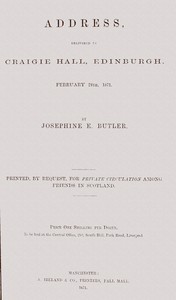
Josephine Butler opens her 1871 Edinburgh address with a striking visual analogy: a painting of Saint Marguerite trampling a dragon, which she interprets as a call to actively oppose evil rather than merely observe it. This image sets the tone for a speech that is both personal and political, as Butler recounts how her attention was first drawn to the system she now challenges. The address, printed for private circulation among Scottish friends, is a tightly argued critique of the Contagious Diseases Acts and related legislation.
Butler's rhetoric is grounded in concrete concerns: the expansion of state doctors' powers, domiciliary visitation, and the erosion of local self-government. She warns that such laws breed sullenness and revengefulness among working men, and that centralization threatens the corporate freedom admired by foreigners. Her language is direct, even blunt, as when she reports a young MP's suggestion to make poverty a crime and her silent retort, 'Thou fool!'
Purity as Active Opposition
Butler's opening image of Saint Marguerite is not a passive ideal of purity. She emphasizes that the saint 'trampled upon' the dragon, and that to escape unhurt, 'we must oppose and tread upon the evil.' Merely looking on, wondering, or being amazed leaves one worse off. This active stance is central to her argument: opposition itself, with its 'pain and vigour, and humble trust in God,' enables one to rise above hurtful influences.
She extends this logic to the work of reform. The messengers God sends to combat impurity are weak, but they need not doubt his power to keep them unharmed. Butler's language here is both spiritual and martial: God gives 'armour fitted for the battle.' The dragon represents not just impurity but also 'wickedness, and cruelty,' and the conqueror's feet remain unsoiled. This framing positions the fight against the Contagious Diseases Acts as a moral crusade where the defender's purity is preserved through engagement, not withdrawal.
The Machinery of Overreach
Butler devotes substantial attention to the practical mechanisms of the laws she opposes. She describes 'the forcible doctoring of the people, whether they will or no' as a dangerous experiment, and lists specific grievances: magisterial powers granted to state doctors, domiciliary visitation legalized for police and medical men, and the imposition of uniform rules on diverse populations. She argues that these measures breed 'much sullenness and revengefulness' among working men, undermining the cooperation necessary for law to function.
Her critique extends to the centralization of authority. She notes that laws administered from London override municipal authority and repress corporate freedom, striking at the 'manly character, the respect for law, and the readiness of resource' that foreigners admire in British local self-government. The forthcoming Sanatory Bill, she warns, will increase state doctors' powers and impose uniformity where self-regulation is healthier. Butler's analysis is grounded in the specifics of legislative process, not abstract principle.
Women's Voices and Domestic Ground
Butler argues that women's influence and faith in the recoverability of human nature are needed in legislative matters. Male legislators, she claims, 'ride rough-shod over us in matters of domestic detail,' applying heavy-handed legislation to everything that concerns conscience and feelings. She warns that women will soon have to fight 'for the last inch of ground left us—not for our civil rights only, but for our hearths, our homes, our beds, our babies, our very persons.'
This is not a plea for inclusion in an existing system but a claim that women's perspective corrects the 'crudeness of intellect' of young male legislators. She illustrates this with an anecdote: a young MP told her that disease was already made a crime and that poverty should be too. Butler's silent response—'Thou fool!'—underscores her disdain for such logic. She proposes a national Covenant or League to vigilantly examine legislative proposals, especially those from 'favoured cliques or professions,' ensuring open debate and majority sanction.
Butler's address is a document of political advocacy as much as moral witness. Readers will find her argument tightly woven around specific legislative threats, not generalities. The painting of Saint Marguerite serves as a recurring touchstone, but the speech's force lies in its detailed critique of state power and its call for women's active role. Those approaching this text should attend to the concrete proposals—the Covenant, the vigilance against centralization—as much as the rhetorical framing. The address rewards careful reading of its legal and political reasoning, which remains strikingly contemporary.
There’s something in Butler’s old address—that quiet insistence on women’s voice against the machinery of state—that reminds me of evenings spent with The Works of Robert Louis Stevenson - Swanston Edition, Vol. 16 — Story, Setting & Ideas, where the resistance is smaller, more personal. Both feel like conversations from another room. I keep returning to that stubborn, human refusal to be governed entirely. It lingers.