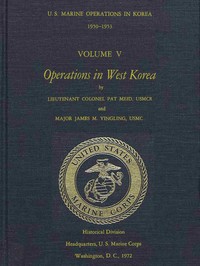
U.S. Marine Operations in Korea, 1950-1953, Volume 5 (of 5)

(26 User reviews)   6722
By Betty Young Posted on Jan 5, 2026
In Category - Attention Control
Yingling, James M. Yingling, James M.
English
Hey, if you think you know the Korean War from the usual history books, think again. James M. Yingling's final volume in this massive series focuses on the brutal, grinding war of movement from 1951 to the armistice. This isn't about sweeping invasions; it's about Marines holding impossible hills, surviving brutal winters, and fighting a war where the front lines barely moved for two years. It’s the story of endurance when the headlines had faded, told through official reports and the raw voices of the men who were there. It completely changed my view of what the later years of that conflict were really like.
Share

Read "U.S. Marine Operations in Korea, 1950-1953, Volume 5 (of 5)" Online

This book is available in the public domain. Start reading the digital edition below.

START READING FULL BOOK
Instant Access    Mobile Friendly

Book Preview

A short preview of the book’s content is shown below to give you an idea of its style and themes.

the enemy’s goal of penetrating to Seoul, the South Korean capital. Northwest of the Marine Main Line of Resistance, less than five miles distant, lay Panmunjom, site of the sporadic truce negotiations. Defense of their strategic area exposed the Marines to continuous and deadly Communist probes and limited objective attacks. These bitter and costly contests for key outposts bore such names as Bunker Hill, the Hook, the Nevadas (Carson-Reno-Vegas), and Boulder City. For the ground Marines, supported by 1st Marine Aircraft Wing squadrons, the fighting continued until the last day of the war, 27 July 1953. The Korean War marked the first real test of Free World solidarity in the face of Communist force. In repulsing this attempted Communist aggression, the United Nations, led by the United States, served notice that it would not hesitate to aid those nations whose freedom and independence were under attack. As events have subsequently proven, holding the line against Communist encroachment is a battle whose end is not yet in sight. Enemy aggression may explode brazenly upon the world scene, with an overt act of invasion, as it did in Korea in June 1950, or it may take the form of a murderous guerrilla war as it has more recently, for over a decade, in Vietnam. Whatever guise the enemy of the United States chooses or wherever he draws his battleline, he will find the Marines with their age-old answer. Today, as in the Korean era, Marine Corps readiness and professionalism are prepared to apply the cutting edge against any threat to American security. [Illustration: (signature)] L. F. CHAPMAN, JR. _General, U.S. Marine Corps,_ _Commandant of the Marine Corps_ Reviewed and approved: 12 May 1971. Preface This is the concluding volume of a five-part series dealing with operations of United States Marines in Korea between 2 August 1950 and 27 July 1953. Volume V provides a definitive account of operations of the 1st Marine Division and the 1st Marine Aircraft Wing during 1952–1953, the final phase of the Korean War. At this time the division operated under Eighth U.S. Army in Korea (EUSAK) control in the far western sector of I Corps, while Marine aviators and squadrons functioned as a component of the Fifth Air Force (FAF). The period covered by this history begins in March 1952, when the Marine division moved west to occupy positions defending the approaches to Seoul, the South Korean capital. As it had for most of the war the 1st Marine Aircraft Wing, operating under FAF, flew close support missions not only for the Marines but for as many as 19 other Allied frontline divisions. Included in the narrative is a detailed account of Marine POWs, a discussion of the new defense mission of Marine units in the immediate postwar period, and an evaluation of Marine Corps contributions to the Korean War. Marines, both ground and aviation, comprised an integral part of the United Nations Command in Korea. Since this is primarily a Marine Corps history, actions of the U.S. Army, Navy, and Air Force are presented only in sufficient detail to place Marine operations in their proper perspective. Official Marine Corps combat records form the basis for the book. This primary source material has been further supplemented by comments and interviews from key participants in the action described. More than 180 persons reviewed the draft chapters. Their technical knowledge and advice have been invaluable. Although the full details of these comments could not be used in the text, this material has been placed in Marine Corps archives for possible use by future historians. The manuscript of this volume...

This is a limited preview. Download the book to read the full content.

This book picks up the story in 1951, after the dramatic Inchon landing and the Chosin Reservoir campaign. The war settles into a stalemate. The big, famous battles are over, replaced by a vicious fight for hills with names like Bunker Hill, the Hook, and Vegas. The Marines are stuck in trench warfare that feels eerily like World War I, but with jet aircraft overhead. The book follows them through these brutal, small-unit actions, the miserable conditions, and the long wait for peace talks to finally mean something.

Why You Should Read It

Most war histories love the grand opening moves. This one is powerful because it focuses on the hard, thankless middle. Yingling uses after-action reports, maps, and personal accounts to show you what it was like to live in a muddy hole for months, under constant threat. You get a real sense of the frustration and gritty professionalism of these Marines. It’s not glamorous, but it feels incredibly honest. The courage on display here isn't in a single dramatic charge, but in the daily choice to hold the line.

Final Verdict

This is essential reading for anyone seriously interested in the Korean War or modern military history. It’s detailed and factual, so it's perfect for history buffs and veterans who appreciate the nitty-gritty. But if you're a general reader who enjoyed books like With the Old Breed, this final volume provides the crucial, often-overlooked context for how that war really ended. It’s the definitive, closing chapter on the USMC's Korean experience.


🔓 No Rights Reserved

This masterpiece is free from copyright limitations. Thank you for supporting open literature.

Michelle Gonzalez
1 year ago

The fonts used are very comfortable for long reading sessions.

Logan Martin
5 months ago

A must-have for anyone studying this subject.

Jackson Wilson
9 months ago

To be perfectly clear, the atmosphere created is totally immersive. A true masterpiece.

Daniel Ramirez
1 year ago

The formatting on this digital edition is flawless.

Noah Jackson
1 year ago

Amazing book.

5
5 out of 5 (26 User reviews )

Add a Review

Your Rating *
There are no comments for this eBook.
You must log in to post a comment.
Log in


Related eBooks