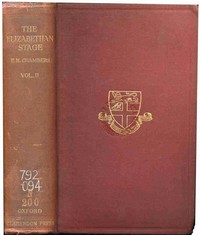
The Elizabethan Stage, Vol. 2 by E. K. Chambers

(15 User reviews)   4925
By Betty Young Posted on Jan 5, 2026
In Category - Digital Minimalism
Chambers, E. K. (Edmund Kerchever), 1866-1954 Chambers, E. K. (Edmund Kerchever), 1866-1954
English
Ever wonder what really happened behind the curtain at Shakespeare's Globe? This isn't just a history book—it's a backstage pass to the wild world of Elizabethan theater. Chambers digs through old records, court documents, and financial ledgers to show us the real drama: the fights between actors, the constant threat of the plague shutting everything down, and how playwrights like Marlowe and Jonson navigated a world of strict censorship. It’s less about perfect poetry and more about the gritty, risky business of putting on a show when your theater could be closed by the authorities or disease at any moment. If you think putting on a play today is tough, wait until you read this.
Share

Read "The Elizabethan Stage, Vol. 2 by E. K. Chambers" Online

This book is available in the public domain. Start reading the digital edition below.

START READING FULL BOOK
Instant Access    Mobile Friendly

Book Preview

A short preview of the book’s content is shown below to give you an idea of its style and themes.

articles in _M. L. R._ ii (1906), 1; iv (1909), 153 (cf. App. B); and a number of documents, new and old, including the texts of all the patents issued to companies, have been carefully edited in vol. i of the _Collections of the Malone Society_ (1907–11). Finally, J. T. Murray, _English Dramatic Companies_ (1910), has collected the published notices of performances in the provinces, added others from the municipal archives of Barnstaple, Bristol, Coventry, Dover, Exeter, Gloucester, Marlborough, Norwich, Plymouth, Shrewsbury, Southampton, Winchester, and York, and on the basis of these constructed valuable accounts of all the London and provincial companies between 1558 and 1642. Most of the present chapter was written before Murray’s book appeared, but it has been carefully revised with the aid of his new material. I have not thought it necessary to refer to my original provincial sources, where they are included in his convenient Appendix G, but in using his book it should be borne in mind that he has made a good many omissions in carrying data from this Appendix to the tables of provincial visits, which he gives for each company. For a few places I have had the advantage of sources not drawn upon by Murray, and these should be treated as the references for any facts as regards such places not discoverable in Murray’s Appendix. They are:--for Belvoir and other houses of the Earls of Rutland, _Rutland MSS._ (_Hist. MSS._), iv. 260; for the house of Richard Bertie and his wife the Duchess of Suffolk at Grimsthorpe, _Ancaster MSS._ (_Hist. MSS._), 459; for Wollaton, the house of Francis Willoughby, _Middleton MSS._ (_Hist. MSS._), 446; for Maldon and Saffron Walden in Essex, A. Clark’s extracts in _10 Notes and Queries_, vii. 181, 342, 422; viii. 43; xii. 41; for Newcastle-on-Tyne, G. B. Richardson, _Reprints of Rare Tracts_, vol. iii, and _10 N. Q._ xii. 222; for Reading, _Hist. MSS._ xi. 177; for Oxford, F. S. Boas in _Fortnightly Review_ (Aug. 1913; Aug. 1918; May 1920); for Stratford, J. O. Halliwell, _Stratford-upon-Avon in the Time of the Shakespeares, illustrated by Extracts from the Council-Books_ (1864); for Weymouth, H. J. Moule, _Weymouth and Melcombe Regis Documents_ (1883), 136; for Dunwich, _Various Collections_ (_Hist. MSS._), vii. 82; for Aldeburgh, Suffolk, C. C. Stopes, _William Hunnis_, 314. References for a few other scattered items are in the foot-notes. The warning should be given that the dates assigned to some of the provincial performances are approximate, and may be in error within a year or so either way. For this there are more reasons than one. The zealous antiquaries who have made extracts from local records have not realized that precise dates might be of value, and have often named a year without indicating whether it represents the calendar year (Circumcision style) or the calendar year (Annunciation style) in which a performance fell, or the calendar year in which a regnal, mayoral, or accounting year, in which the performance fell, began or ended. When they are clearly dealing with accounting years, they do not always indicate whether these ended at Michaelmas or at some other date. They sometimes give only the year of a performance, when they might have given, precisely or approximately, the month and day of the month as well. But it is fair to add that the accounts of City Chamberlains and similar officers, from which the notices of plays are generally derived, are not always so kept as to render precise dating feasible. Some accountants specify the days, others the weeks to which their entries relate; others put their entries in chronological...

This is a limited preview. Download the book to read the full content.

The Story

This book doesn't have a plot in the traditional sense. Instead, it pieces together the true story of English theater from about 1576 to 1616. Chambers acts like a detective, using surviving documents to show how companies of actors were formed, how they built famous playhouses like The Globe and The Rose, and how they survived in a city often hostile to their work. The real conflict isn't on the stage, but between the players and the city officials who wanted to shut them down, or the outbreaks of sickness that emptied the theaters for months.

Why You Should Read It

It makes the Elizabethan stage feel alive and messy. You get to see Shakespeare not as a lonely genius, but as a working member of a company, dealing with practical problems. The book is filled with surprising details—like how boy actors played the female roles, or how a flag flying above the theater meant a show was on that day. It connects the beautiful words we still read to the very real, often chaotic world that produced them.

Final Verdict

This is for anyone who loves Shakespeare or theater history and wants to go deeper. It's perfect for the reader who finishes a play and immediately wonders, 'But how did they actually *do* this?' It’s not a light read, but it's incredibly rewarding. Think of it as the ultimate special features section for the greatest era of English drama.


🔓 Legal Disclaimer

You are viewing a work that belongs to the global public domain. Share knowledge freely with the world.

Jackson Allen
8 months ago

Great reference material for my coursework.

Betty Clark
1 year ago

Finally a version with clear text and no errors.

Noah Rodriguez
1 year ago

Perfect.

Jennifer Williams
1 year ago

Based on the summary, I decided to read it and the content flows smoothly from one chapter to the next. Thanks for sharing this review.

Matthew Sanchez
7 months ago

I was skeptical at first, but the storytelling feels authentic and emotionally grounded. Highly recommended.
5
5 out of 5 (15 User reviews )

Add a Review

Your Rating *
There are no comments for this eBook.
You must log in to post a comment.
Log in


Related eBooks