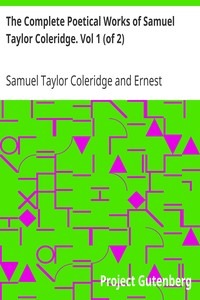
The Complete Poetical Works of Samuel Taylor Coleridge. Vol 1 (of 2) by Coleridge

(13 User reviews)   5853
By Betty Young Posted on Dec 25, 2025
In Category - Online Safety
Coleridge, Samuel Taylor, 1772-1834 Coleridge, Samuel Taylor, 1772-1834
English
Ever read a poem that made you feel like you were dreaming while awake? That's Coleridge for you. This first volume collects his most famous work, including 'The Rime of the Ancient Mariner'—the haunting tale of a sailor who kills an albatross and brings a curse upon his ship. It's a story about guilt, the supernatural, and man's shaky relationship with nature. But this book isn't just one famous poem; it's a doorway into a mind obsessed with imagination, from the unfinished fantasy of 'Kubla Khan' to his quieter, personal verses. If you think classic poetry is stiff or boring, this collection might just change your mind.
Share

Read "The Complete Poetical Works of Samuel Taylor Coleridge. Vol 1 (of 2) by Coleridge" Online

This book is available in the public domain. Start reading the digital edition below.

START READING FULL BOOK
Instant Access    Mobile Friendly

Book Preview

A short preview of the book’s content is shown below to give you an idea of its style and themes.

Some words and phrases have a line drawn through them in the original. These struck out words are enclosed in brackets with asterisks like this: [*these words are struck through*] Other Transcriber's Notes follow the text. THE COMPLETE POETICAL WORKS OF SAMUEL TAYLOR COLERIDGE INCLUDING POEMS AND VERSIONS OF POEMS NOW PUBLISHED FOR THE FIRST TIME EDITED WITH TEXTUAL AND BIBLIOGRAPHICAL NOTES BY ERNEST HARTLEY COLERIDGE M.A., HON. F.R.S.L. IN TWO VOLUMES VOL. I: POEMS [Illustration] OXFORD AT THE CLARENDON PRESS 1912 PREFACE The aim and purport of this edition of the _Poetical Works_ of Samuel Taylor Coleridge is to provide the general reader with an authoritative list of the poems and dramas hitherto published, and at the same time to furnish the student with an exhaustive summary of various readings derived from published and unpublished sources, viz. (1) the successive editions issued by the author, (2) holograph MSS., or (3) contemporary transcriptions. Occasion has been taken to include in the Text and Appendices a considerable number of poems, fragments, metrical experiments and first drafts of poems now published for the first time from MSS. in the British Museum, from Coleridge's Notebooks, and from MSS. in the possession of private collectors. The text of the poems and dramas follows that of the last edition of the _Poetical Works_ published in the author's lifetime--the three-volume edition issued by Pickering in the spring and summer of 1834. I have adopted the text of 1834 in preference to that of 1829, which was selected by James Dykes Campbell for his monumental edition of 1893. I should have deferred to his authority but for the existence of conclusive proof that, here and there, Coleridge altered and emended the text of 1829, with a view to the forthcoming edition of 1834. In the Preface to the 'new edition' of 1852, the editors maintain that the three-volume edition of 1828 (a mistake for 1829) was the last upon which Coleridge was 'able to bestow personal care and attention', while that of 1834 was 'arranged mainly if not entirely at the discretion of his latest editor, H. N. Coleridge'. This, no doubt, was perfectly true with regard to the choice and arrangement of the poems, and the labour of seeing the three volumes through the press; but the fact remains that the text of 1829 differs from that of 1834, and that Coleridge himself, and not his 'latest editor', was responsible for that difference. I have in my possession the proof of the first page of the 'Destiny of Nations' as it appeared in 1828 and 1829. Line 5 ran thus: 'The Will, the Word, the Breath, the Living God.' This line is erased and line 5 of 1834 substituted: 'To the Will Absolute, the One, the Good' and line 6, 'The I AM, the Word, the Life, the Living God,' is added, and, in 1834, appeared for the first time. Moreover, in the 'Songs of the Pixies', lines 9, 11, 12, 15, 16, as printed in 1834, differ from the readings of 1829 and all previous editions. Again, in 'Christabel' lines 6, 7 as printed in 1834 differ from the versions of 1828, 1829, and revert to the original reading of the MSS. and the First Edition. It is inconceivable that in Coleridge's lifetime and while his pen was still busy, his nephew should have meddled with, or remodelled, the master's handiwork. The poems have been printed, as far as possible, in chronological order, but when no MS. is extant, or when the MS. authority is a first draft embodied in a notebook, the exact date...

This is a limited preview. Download the book to read the full content.

This isn't a novel with a single plot, but a journey through one poet's incredible imagination. The centerpiece is 'The Rime of the Ancient Mariner,' a ghostly sea ballad where a sailor's thoughtless act unleashes a nightmare. We follow his cursed voyage, surrounded by deathly stillness and spectral visitors, as he searches for redemption. Alongside this, you get the hypnotic fragments of 'Kubla Khan,' born from an opium dream, and conversational poems like 'Frost at Midnight' where Coleridge muses on nature and his sleeping baby.

Why You Should Read It

Coleridge's power is in his imagery. He doesn't just describe a scene; he pulls you into it. You feel the 'slimy things' crawl on the rotting sea in 'The Ancient Mariner,' and you can almost hear the 'mighty fountain' in 'Kubla Khan.' Reading him feels active and immersive. Beyond the spooky stuff, there's a deep humanity here—his struggles with faith, his love for his children, and his belief in the creative mind shine through in quieter moments.

Final Verdict

Perfect for anyone who loves a good ghost story or myth, but wants more substance. If you're new to poetry and want to start with something gripping, the narrative drive of 'The Ancient Mariner' is a fantastic entry point. It's also a treat for daydreamers and anyone who believes that the best stories often live in the shadowy places between reality and imagination. Keep an open mind, and let the old sailor stop you on your way—you won't regret listening.


ℹ️ Public Domain Content

This digital edition is based on a public domain text. It is available for public use and education.

Linda Harris
1 year ago

Not bad at all.

Sandra Martin
1 year ago

I stumbled upon this title and the narrative structure is incredibly compelling. I couldn't put it down.

Kenneth Martinez
1 year ago

The fonts used are very comfortable for long reading sessions.

Ava Wright
1 year ago

I came across this while browsing and the content flows smoothly from one chapter to the next. A true masterpiece.

Brian Gonzalez
2 years ago

Finally a version with clear text and no errors.

4.5
4.5 out of 5 (13 User reviews )

Add a Review

Your Rating *
There are no comments for this eBook.
You must log in to post a comment.
Log in


Related eBooks