
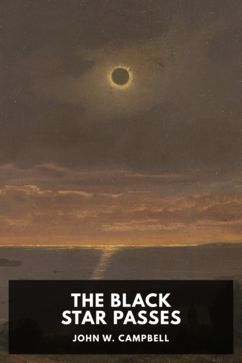
The Black Star Passes - John W. Campbell
Read "The Black Star Passes - John W. Campbell" Online
This book is available in the public domain. Start reading the digital edition below.
Book Preview
A short preview of the book’s content is shown below to give you an idea of its style and themes.
Let's set the scene: Earth has finally cracked interstellar travel, buzzing with new ships and big ideas. The future looks bright. Then, everything stops. A smooth, featureless black sphere materializes in orbit. It's silent, immovable, and completely ignores all attempts at communication. Our planet's top minds are baffled. Enter our heroes: the physicist Arcot, the mathematician Morey, and the engineer Wade. They're not soldiers; they're thinkers thrown into the ultimate mental showdown.
The Story
The book follows this brilliant trio as they race to unravel the sphere's secrets. They can't blow it up—they don't even know what it's made of. Instead, they have to out-think it. The story is a chain of scientific detective work, each breakthrough leading to a bigger mystery. They reverse-engineer alien technology, push their own ships to insane limits, and eventually take the fight to the stars to confront the power behind the sphere. It's a journey from confusion, to understanding, to a confrontation that redefines humanity's place in the cosmos.
Why You Should Read It
Forget laser battles; the excitement here is intellectual. Campbell, who later shaped the Golden Age of Sci-Fi as an editor, fills this story with wild, 'what if' science. The joy is in watching ideas clash and evolve. Arcot, Morey, and Wade feel like a classic team—each with a specialty, bouncing concepts off each other. The core theme isn't war, but problem-solving. It asks a timeless question: when faced with the utterly unknown, do we give up, or do we learn?
Final Verdict
This is a must-read for anyone who loves the 'sense of wonder' at the heart of old-school science fiction. It's perfect for fans of Isaac Asimov's puzzle plots or the scientific optimism of the early Space Age. If you prefer character drama over science puzzles, you might find it a bit technical. But if you've ever stared at the stars and wondered 'how would we even begin to talk to something out there?'—this book is your blueprint. It's a fun, fast-paced tribute to human cleverness, straight from the genre's founding days.
This content is free to share and distribute. It serves as a testament to our shared literary heritage.
Paul Lopez
5 months agoThe information is current and very relevant to today's needs.
Michael Harris
9 months agoWhile browsing through various academic sources, the author clearly has a deep mastery of the subject matter. A trustworthy resource that I'll keep in my digital library.
Christopher Lopez
6 months agoI started reading this with a critical mind, the author clearly has a deep mastery of the subject matter. A trustworthy resource that I'll keep in my digital library.
Kimberly Anderson
2 months agoThe author provides a very nuanced critique of current methodologies.

William Harris
1 year agoInitially, I was looking for a specific answer, but it manages to maintain a consistent flow even when discussing difficult topics. I'll be citing this in my upcoming project.