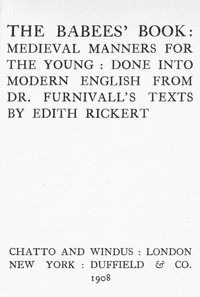
The Babees' Book: Medieval Manners for the Young: Done into Modern English

(19 User reviews)   7225
By Betty Young Posted on Dec 25, 2025
In Category - Online Safety
English
Ever wonder what a medieval parent would tell their kids about table manners? This book is basically the 15th-century version of 'don't put your elbows on the table,' but it's so much weirder and more wonderful. It’s a tiny, strange time capsule that shows how some things (like wanting kids to behave) never change, while other advice (like how to properly carve a peacock) has definitely gone out of style. It’s funny, surprisingly sweet, and gives you a peek into the everyday minds of people who lived 600 years ago.
Share

Read "The Babees' Book: Medieval Manners for the Young: Done into Modern English" Online

This book is available in the public domain. Start reading the digital edition below.

START READING FULL BOOK
Instant Access    Mobile Friendly

Book Preview

A short preview of the book’s content is shown below to give you an idea of its style and themes.

modern form. Therefore this little volume has been undertaken. Doubtless unwritten codes of behaviour are coeval with society; but the earliest treatises that we possess emphasize morals rather than manners. Even the late Latin author known as Dionysius Cato (fourth century?), whose maxims were constantly quoted, translated, imitated, and finally printed during the late Middle Ages, does not touch upon the niceties of conduct that we call manners; wherefore one John Garland, an Englishman educated at Oxford, who lived much in France during the first half of the thirteenth century, felt bound to supplement Cato on these points. His work, entitled _Liber Faceti: docens mores hominum, precipue iuuenum, in supplementum illorum qui a moralissimo Cathone erant omissi iuuenibus utiles_,[2] is alluded to as _Facet_ in the first piece in this volume, and serves as basis for part of the _Book of Courtesy_. But, earlier than this, Thomasin of Zerklaere, about 1215, wrote in German a detailed treatise on manners called _Der Wälsche Gast_.[3] And in 1265, Dante’s teacher, Brunetto Latini, published his _Tesoretto_,[3] which was soon followed by a number of similar treatises in Italian. While we need not hold with the writer of the _Little Children’s Little Book_, that courtesy came down from heaven when Gabriel greeted the Virgin, and Mary and Elizabeth met, we must look for its origin somewhere; and inasmuch as, in its medieval form at least, it is closely associated with the practices of chivalry, we may not unreasonably suppose it to have appeared first in France. And although most of the extant French treatises belong to the fourteenth or fifteenth centuries, a lost book of courtesy, translated by Thomasin of Zerklaere, is sometimes held, on good grounds, to have been derived from French, rather than from Italian. In any case, such of the English books as were not taken immediately from Latin, came from French sources. To be sure, there is a Saxon poem, based it would seem on Cato, though by no means a translation, called _A Father’s Instructions to his Son_; but this, although it is greatly exercised about the child’s soul, takes no thought for his finger-nails or his nose. It is not, therefore, surprising to find that nearly all English words denoting manners are of French origin—_courtesy_, _villainy_, _nurture_, _dignity_, _etiquette_, _debonaire_, _gracious_, _polite_, _gentilesse_, &c., while to balance them I can, at this moment, recall only three of Saxon origin—_thew_ (which belongs rather to the list of moral words in which Old English abounds), _churlish_ and _wanton_ (without breeding), both of which, significantly enough, are negative of good manners. The reason for the predominance of the French terms is simply that “French use these gentlemen,” as one old writer puts it; that is, from the Conquest until the latter part of the fourteenth century the language of the invaders prevailed almost entirely among the upper classes, who, accordingly, learned their politeness out of French or Latin books; and it was only with the growth of citizenship and English together, that these matters came to be discussed in this latter tongue for the profit of middle-class children, as well as of the “bele babees” at Court. We must suppose, from numerous hints and descriptions, that an elaborate system of manners and customs prevailed long before it was codified. The Bayeux tapestry (eleventh century) shows a feast, with a server kneeling to serve, his napkin about his neck, as John Russell prescribes some four hundred years later. The romances again, alike in French and in English, describe elaborate ceremonies, and allude constantly to definite laws of courtesy. Now and again we...

This is a limited preview. Download the book to read the full content.

The Story

There isn't a plot in the traditional sense. Instead, this is a collection of instructions translated from Middle English, originally meant to teach young nobles and wealthy children how to act in polite society. Think of it as a medieval etiquette guide. It covers everything from how to wash your hands before a meal (very important!) to how to serve your lord, how to behave at the table, and even how to dress properly. The 'characters' are the anonymous writers and the young 'Babees' they're trying to instruct.

Why You Should Read It

Reading this feels like overhearing a conversation from another world. The advice is a mix of the utterly familiar ('Don't talk with your mouth full') and the hilariously archaic. You'll learn that you shouldn't scratch your dog at the dinner table, and that staring at someone like a 'sparrow-hawk' is rude. It's these small, human details that make the past feel real. It’s not about kings and battles; it’s about a kid trying to remember not to blow on his soup. The book is short, and each little rule is a delightful glimpse into what mattered to people back then.

Final Verdict

This is a perfect little book for anyone with a casual interest in history, fans of quirky non-fiction, or parents who might want some historical perspective on their kids' manners! It's not a heavy academic text. Read a few pages at a time, chuckle at the odd advice, and marvel at how the goal of raising a decent person hasn't changed all that much, even if the methods have.


🟢 Copyright Free

This historical work is free of copyright protections. Feel free to use it for personal or commercial purposes.

Michael Hill
1 month ago

I came across this while browsing and the pacing is just right, keeping you engaged. Truly inspiring.

Mark Wright
1 year ago

Wow.

Donna Moore
1 year ago

Five stars!

Elizabeth King
1 year ago

Perfect.

Sandra Smith
5 months ago

Surprisingly enough, the depth of research presented here is truly commendable. Worth every second.

5
5 out of 5 (19 User reviews )

Add a Review

Your Rating *
There are no comments for this eBook.
You must log in to post a comment.
Log in


Related eBooks