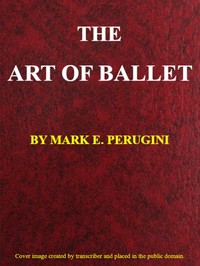
The Art of Ballet by Mark Edward Perugini

(2 User reviews)   718
By Betty Young Posted on Jan 14, 2026
In Category - Tech Balance
Perugini, Mark Edward, 1876?-1948 Perugini, Mark Edward, 1876?-1948
English
Hey, you know how we always think of ballet as these perfect, floating dancers in tutus? Well, Mark Edward Perugini's 'The Art of Ballet' totally flips that script. It's not a story about a specific performance or dancer, but the wild, dramatic, and surprisingly gritty history behind the whole art form. The 'conflict' here is between the beautiful illusion on stage and the messy, passionate, and often controversial reality that created it. Perugini takes you backstage through centuries, showing how political scandals, social clashes, and pure artistic rebellion shaped every plié and pirouette we see today. It reads like uncovering a secret history—you'll never watch 'Swan Lake' the same way again. If you've ever been curious about what really goes on behind the velvet curtain, this is your backstage pass.
Share

Read "The Art of Ballet by Mark Edward Perugini" Online

This book is available in the public domain. Start reading the digital edition below.

START READING FULL BOOK
Instant Access    Mobile Friendly

Book Preview

A short preview of the book’s content is shown below to give you an idea of its style and themes.

Berlin, Copenhagen, Stockholm, Warsaw, or Petrograd (formerly St. Petersburg), not to speak of the United States and South America. This, however, would be to miss somewhat the author’s purpose, which is not to trace the growth of Ballet in every capital where it has been seen. To do so effectively were hardly possible in a single volume. A whole book might well be devoted to the history of the art in Italy alone, herein only touched upon as it came to have vital influence on France and England in the nineteenth century. We have already had numerous volumes dealing with Russian Ballet; and since the ground has been extensively enough surveyed in that direction there could be no particular advantage in devoting more space to the subject than is already given to it in this work, the purpose of which only is to present--as far as possible from contemporary sources--some leading phases of the history of the modern Art of Ballet as seen more particularly in France and England. A brief series of biographical essays “Cameos of the Dance,” by the same writer, was published in _The Whitehall Review_ in 1909; various articles on the subject also being contributed to _The Evening News_, _Lady’s Pictorial_, _Illustrated Sporting and Dramatic News_, _Pall Mall Gazette_ and other London journals during 1910 and 1911; and a series of “Sketches of the Dance and Ballet,” coming from the same hand, appeared in _The Dancing Times_, 1912, 1913 and 1914. They were based on portions of the manuscript of the present work which, begun some years ago by way of pastime, and written during the scant leisure of a crowded business life, was completed at the publisher’s request, and was--save for a few brief insertions in the proofs--ready, and announced for publication before the Great War began in August 1914. The preparation of this book has involved the marshalling of a vast array of facts and dates, the delving into and comparison of some three hundred or more ancient and modern volumes on dancing and on theatrical and operatic history, the study of scores of old newspaper-files and long-forgotten theatrical “repositories” and souvenirs. Error is always possible in spite of care, and if it should have happened here the writer will be grateful for correction. In covering so wide a field a full bibliography becomes impossible from limits of space; but to those interested the following list of leading authorities--supplemented by those referred to in the text--may be of service. “La Danse Grecque Antique,” by M. Emmanuel; “Roman Life and Manners under the Early Empire,” by L. Friedländer; “Dramatic Traditions of the Dark Ages,” by Joseph S. Tunison (University of Chicago Press); “Orchésographie,” by Thoinot Arbeau (1588); “Des Ballets Anciens et Modernes,” by Père Menestrier (1682); “La Danse Antique et Moderne,” by De Cahuzac (1754); “The Code of Terpsichore,” by Carlo Blasis (1823); “Dictionnaire de la Danse,” by G. Desrat (1895); “Dancing in all Ages,” by Edward Scott (1899); “Histoire de la Danse,” by F. de Menil (1905); and “The Dance: Its Place in Art and Life,” by T. and M. W. Kinney (1914). CONTENTS _BOOK I. THE FIRST ERA_ CHAPTER PAGE OVERTURE: ON THE ART OF BALLET 15 I. A DISTINCTION, AND SOME DIFFERENCES 21 II. EGYPT 25 III. GREECE 32 IV. MIME AND PANTOMIME: ROME, HIPPODROME--OBSCURITY 41 V. CHURCH THUNDER AND CHURCH COMPLAISANCE 47 VI. A BANQUET-BALL OF 1489: AND THE BALLET COMIQUE DE LA REINE, 1581 53 VII. THOINOT ARBEAU’s “ORCHÉSOGRAPHIE,” 1588 61 VIII. SCENIC EFFECT: THE ENGLISH MASQUE AS BALLET, 1585-1609 71 IX. BALLET ON THE MOVE 83 X. COURT BALLETS...

This is a limited preview. Download the book to read the full content.

Forget everything you think you know about ballet as a pristine, unchanging art. Mark Edward Perugini’s The Art of Ballet is a journey into its beating heart, tracing the dance from its royal court origins to the modern stage. This isn't a dry timeline of dates and names. Perugini writes like a guide showing you around a fascinating, crowded room, pointing out the dramas and personalities that changed everything.

The Story

There isn't a single plot, but there is a powerful narrative: the story of ballet's survival and transformation. The book shows how ballet was born in Italian Renaissance courts, then groomed in the opulent theaters of France under kings like Louis XIV. It follows the dance as it gets tangled in politics, becomes a tool for national pride in Russia, and gets shaken up by artistic revolutionaries. You meet the fiery choreographers who fought tradition, the dancers who became international celebrities, and the composers whose music gave ballet its soul. It's the true story of how an art form made for kings became a passion for the world.

Why You Should Read It

What makes this book special is Perugini's genuine excitement. He writes with the warmth of a true fan who also knows all the gossip. You get the sense he’s not just listing facts, but telling you why they matter. He connects the dots between a political uprising in Paris and a new style of movement, or between a dancer's personal scandal and a shift in public taste. He makes you see that every graceful step on stage today is the answer to a historical question or a creative battle fought long ago. It gives you a whole new layer of appreciation.

Final Verdict

This book is a perfect fit for curious minds who love art, history, or a good story about human passion. It's for the ballet-goer who wants to understand the 'why' behind the beauty. It's also a great pick for anyone who thinks history books are boring—Perugini proves they don't have to be. While it was written in the early 20th century, its focus on the people and forces that shape art feels timeless. Just be ready to have your romantic ideas about tutus and tiaras challenged by the much more interesting truth.


🔖 Public Domain Content

This publication is available for unrestricted use. Enjoy reading and sharing without restrictions.

Ava Rodriguez
6 months ago

Recommended.

Christopher Lee
7 months ago

Comprehensive and well-researched.

3.5
3.5 out of 5 (2 User reviews )

Add a Review

Your Rating *
There are no comments for this eBook.
You must log in to post a comment.
Log in


Related eBooks