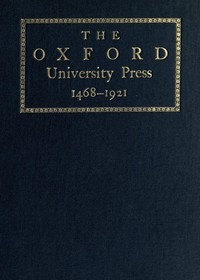
Some Account of the Oxford University Press, 1468-1921 by Oxford University Press

(16 User reviews)   6856
By Betty Young Posted on Dec 25, 2025
In Category - Digital Minimalism
English
Ever wondered how a single university press became one of the most famous and powerful names in the world of books? 'Some Account of the Oxford University Press, 1468-1921' is a surprisingly gripping story about how a small, local print shop grew into a global institution. It's not just about printing dates and typefaces. It's a real-life drama about money problems, huge arguments over what to publish (like the famous Oxford English Dictionary), and the constant struggle to balance academic ideals with the need to actually sell books. If you think the history of a publisher sounds dry, this book will change your mind.
Share

Read "Some Account of the Oxford University Press, 1468-1921 by Oxford University Press" Online

This book is available in the public domain. Start reading the digital edition below.

START READING FULL BOOK
Instant Access    Mobile Friendly

Book Preview

A short preview of the book’s content is shown below to give you an idea of its style and themes.

After 1520 there is a gap in the history, which begins again in 1585. The Chancellor of that time was Queen Elizabeth’s favourite, the Earl of Leicester, who in the first issue of the new Press is celebrated as its founder. Convocation in 1584 had appointed a committee _De Libris imprimendis_, and in 1586 the University lent £100 to an Oxford bookseller, Joseph Barnes, to carry on a press. In the next year an ordinance of the Star Chamber allowed one press at Oxford, and one apprentice in addition to the master printer. Barnes managed the Press until 1617, and printed many books now prized by collectors, among them the first book printed at Oxford in Greek (the Chrysostom of 1586), the first book with Hebrew type (1596), Richard de Bury’s _Philobiblon_, and Captain John Smith’s _Map of Virginia_. FOUR FOUNDERS OF THE OXFORD UNIVERSITY PRESS [Illustration: Robert Dudley, Earl of Leicester] [Illustration: Archbishop Laud] [Illustration: Dr. John Fell] [Illustration: Edward Hyde, Earl of Clarendon] [Illustration: THE INTERIOR OF THE OLD CONGREGATION HOUSE The first printing-house owned by the University; used for storing Oriental type and printing-furniture, 1652.] [Illustration: Upper part of the first page of the Oxford (now London) Gazette, 1665. The oldest newspaper still existing in England] The first notable promoter of the Oxford Press was Archbishop Laud, whose statutes contemplate the appointment of an _Architypographus_, and who secured for the University in 1632 Letters Patent authorizing three printers (each with two presses and two apprentices), and in 1636 a Royal Charter entitling the University to print ‘all manner of books’. The privilege of printing the Bible was not exercised at this date; but in 1636 Almanacks were produced, and this seems to have alarmed the Stationers’ Company, who then enjoyed a virtual monopoly of Bibles, Grammars, and Almanacks; for we find that in 1637 the University surrendered the privilege to the Stationers for an annual payment of £200, twice the amount of Joseph Barnes’s working capital. The most famous books belonging to what may be called the Laudian period were five editions of Burton’s _Anatomy of Melancholy_ and one of Bacon’s _Advancement of Learning_ in English. [Illustration: OXFORD UNIVERSITY ARMS Some ancient examples used by the Oxford University Press] [Illustration] [Illustration: From _The History of Lapland_ by John Shefferus, 1674, the first anthropological book published by the Press] The work of the Press during the Civil War is of interest to historians and bibliographers on account of the great number of Royalist Pamphlets and Proclamations issued while the Court of Charles I was at Oxford; a number swollen in appearance by those printed in London with counterfeit Oxford imprints. But this period is not important in the history of the Learned Press; and after 1649 it suffered a partial eclipse which did not pass until the Restoration. [Illustration: From W. Maundrell’s _Journey from Aleppo to Jerusalem_, Oxford, 1703, engraved by M. Burghers] The history of the Press in the latter part of the seventeenth century will always be connected with the name of the second of its great patrons, Dr. John Fell, Dean of Christ Church and Bishop of Oxford. Fell made the great collection of type-punches and matrices from which the beautiful types known by his name are still cast at Oxford; he promoted the setting up of a paper mill at Wolvercote, where Oxford paper is still made; he conducted the long, and ultimately successful, struggle with the Stationers and the King’s Printers, from which the history of Oxford Bibles and Prayer Books begins (1675). In 1671 he and three others took over the management...

This is a limited preview. Download the book to read the full content.

This isn't a standard story with a hero and a villain. Instead, it's the biography of an institution. The book traces the Press's journey from its hazy beginnings (possibly as early as 1468!) through its official founding in the 1580s. It follows its growth from a small operation serving the university to a massive, complex organization with a global reach. The narrative is built around the people who ran it, the big projects they took on (like the monumental Bible printing and the creation of the OED), and the constant financial and logistical hurdles they faced.

Why You Should Read It

I picked this up expecting a dry corporate history, but I was completely wrong. The real magic is in the details. You get these fantastic, almost gossipy stories about editors fighting with lexicographers, and the sheer, mind-boggling effort it took to compile a dictionary by hand. It makes you appreciate every Oxford Classic on your shelf in a whole new way. It’s a story about ambition, obsession with quality, and the messy, human reality behind creating objects of timeless authority.

Final Verdict

Perfect for history buffs who love a good origin story, book lovers curious about how their favorite editions came to be, and anyone who enjoys seeing how big, beautiful, and complicated things get made. It’s a niche subject, but told with a warmth and clarity that pulls you right in. You'll never look at a title page the same way again.


🟢 Open Access

This digital edition is based on a public domain text. You are welcome to share this with anyone.

Sandra Smith
1 year ago

I started reading out of curiosity and the atmosphere created is totally immersive. Thanks for sharing this review.

Kenneth Johnson
10 months ago

This book was worth my time since it manages to explain difficult concepts in plain English. I couldn't put it down.
Lisa Thomas
7 months ago

This book was worth my time since the plot twists are genuinely surprising. I couldn't put it down.

Patricia Thompson
1 year ago

Beautifully written.

Mark Allen
1 year ago

My professor recommended this, and I see why.

5
5 out of 5 (16 User reviews )

Add a Review

Your Rating *
There are no comments for this eBook.
You must log in to post a comment.
Log in


Related eBooks