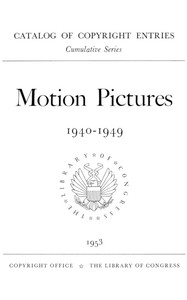
Motion pictures, 1940-1949 : Catalog of copyright entries

(4 User reviews)   954
By Betty Young Posted on Jan 14, 2026
In Category - Online Safety
Library of Congress. Copyright Office Library of Congress. Copyright Office
English
Okay, hear me out. You know that feeling when you're watching a classic movie and you spot a weird, uncredited actor in the background? Or you're trying to remember the name of that one noir film from 1947? This book is the ultimate answer key. It's not a storybook; it's a massive, official list from the U.S. Copyright Office of every single movie registered between 1940 and 1949. Think of it as the phone book for Hollywood's golden age. The 'mystery' here is what you'll find inside. It's a raw, unfiltered snapshot of what studios thought was worth legally protecting—from the Oscar winners we still celebrate to the forgotten B-movies and short subjects that vanished from history. Flipping through it feels like detective work, piecing together the real landscape of filmmaking during World War II and the postwar boom, one dry legal entry at a time. It's surprisingly addictive for anyone who loves to get lost in the details.
Share

Read "Motion pictures, 1940-1949 : Catalog of copyright entries" Online

This book is available in the public domain. Start reading the digital edition below.

START READING FULL BOOK
Instant Access    Mobile Friendly

Book Preview

A short preview of the book’s content is shown below to give you an idea of its style and themes.

in the Copyright Office of the title, description, and required prints. The entries for published works contain date of publication as given in the application for registration. Deposit of published copies has in every case been made. In each entry the name of the claimant is that given in the application. Information relating to renewal copyrights or to subsequent changes of ownership recorded in the Copyright Office can be ascertained upon request and upon payment to the Register of Copyrights of the fee specified in the law for the conduct of a search of the records. In addition, information relating to renewal copyrights can be secured by referring to the issue of the _Catalog of Copyright Entries_ covering renewal registrations for the particular class of work during the renewal period. The publication of the _Catalog of Copyright Entries_ is authorized by sections 210 and 211 of Title 17 of the _United States Code_. Section 210 provides in part: “The current catalog of copyright entries and the index volumes herein provided for shall be admitted in any court as prima facie evidence of the facts stated therein as regards any copyright registration.” The purpose of the cumulative catalogs is threefold: 1) to meet the administrative needs of the Copyright Office; 2) to provide compact index volumes to the legal profession, publishers, authors, and others interested in copyright; and 3) to make available, for other research uses, the information on record in the Copyright Office, much of which is not available elsewhere. A description (including price and instructions for ordering) of each part of the present Third Series of the _Catalog of Copyright Entries_ and of other publications of the Copyright Office is provided at the back of this volume. The Copyright Office welcomes inquiries, suggestions, and comments on the content and organization of the _Catalog_. Such communications should be addressed to the Chief of the Cataloging Division, Copyright Office, Library of Congress, Washington 25, D. C. Copyright Registrations of Motion Pictures January 1, 1940–December 31, 1949 Class L, Motion-picture photoplays 7,122 Class M, Motion pictures other than photoplays 11,645 —————— Total 18,767 Class M contains many animated cartoons and newsreels as well as nontheatrical films. The letter P following the class symbol in an entry indicates that the film was registered as a published work; the letter U, an unpublished work. How To Use This Catalog This catalog consists of three parts: _Motion Pictures, 1940–1949_, which is a list of main entries under title; an _Index_ of names; and a _Series List_. Each part is arranged alphabetically. Motion Pictures, 1940–1949 The items which constitute each entry in this section are given below in the order in which they appear. The title, name of the claimant, copyright date, and registration number are always given; other items are included if applicable to the motion picture and available. 1. _Title._ Main title, followed by subtitle, translated title, and alternate title. Cross-references are made for alternate and translated titles. When motion pictures are based on the lives of real persons or when such persons are mentioned in the titles in connection with specific episodes in their lives, such as musical performances or athletic events, their names are included in the _Index_. 2. _Production statement._ The name of the producing company, i.e., the company responsible for the existence of the picture, follows the title. In some instances two companies or organizations are concerned with the production of a film, one with the physical production, i.e., photographing, editing, sound recording, etc., the other with planning, distributing, and sponsoring the motion picture. In such case the company concerned...

This is a limited preview. Download the book to read the full content.

Let's be clear from the start: this is not a novel. "Motion Pictures, 1940-1949: Catalog of Copyright Entries" is exactly what the title says. Published by the Library of Congress Copyright Office, it's a printed volume listing the thousands of films registered for copyright protection in that decade. Each entry is a bare-bones record: the film's title, the copyright claimant (usually a studio), the date of registration, and a registration number.

The Story

There's no traditional plot. Instead, the 'narrative' is the decade itself, told through bureaucracy. You start in 1940, with entries for films like The Grapes of Wrath and Fantasia. As you move through the years, you see the war effort reflected in titles and claimants. You witness the rise of new studios and the sheer volume of production—features, serials, cartoons, newsreels, and industrial films all listed side-by-side. The 'story' ends in 1949, on the cusp of a new era in film with television looming. The book doesn't analyze or connect the dots; it just lays out the raw data, page after fascinating page.

Why You Should Read It

I'll be honest, I bought this as a reference tool for my blog. But I found myself just browsing it for fun. There's a strange magic in its completeness. You see the famous (Casablanca, It's a Wonderful Life) right next to the utterly obscure ("Socko the Sea Serpent" or "Curing the Common Cold with Mustard Plasters"). It democratizes film history. This catalog doesn't care about a movie's budget or critical reception; if it was copyrighted, it's in here. It's a powerful reminder of how much of our film heritage is made up of these forgotten works. For a researcher or a true film nerd, it's a treasure trove. You can trace a director's early work, see when a studio first copyrighted a famous character, or just marvel at the wonderfully weird titles that didn't stand the test of time.

Final Verdict

This is a niche book, but for the right person, it's a goldmine. Perfect for film historians, researchers, archivists, and the most dedicated classic movie fans. If you love diving into IMDb trivia or watching deep-cut DVD special features, you'll appreciate this primary source. It's not for casual reading, but as a reference or a unique piece of film history to explore, it's utterly compelling. Think of it as the ultimate, authoritative list for one of Hollywood's most important decades.


📜 Open Access

This text is dedicated to the public domain. Share knowledge freely with the world.

Daniel King
4 months ago

I stumbled upon this title and the atmosphere created is totally immersive. A true masterpiece.

Liam Hill
1 year ago

Not bad at all.

Edward Harris
1 year ago

Honestly, the author's voice is distinct and makes complex topics easy to digest. Exactly what I needed.

Emily Taylor
1 year ago

From the very first page, the author's voice is distinct and makes complex topics easy to digest. I learned so much from this.

4.5
4.5 out of 5 (4 User reviews )

Add a Review

Your Rating *
There are no comments for this eBook.
You must log in to post a comment.
Log in


Related eBooks