
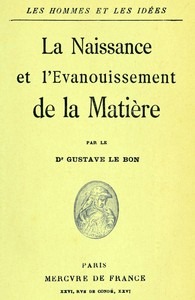
La naissance et l'évanouissement de la matière by Gustave Le Bon
Read "La naissance et l'évanouissement de la matière by Gustave Le Bon" Online
This book is available in the public domain. Start reading the digital edition below.
START READING FULL BOOKBook Preview
A short preview of the book’s content is shown below to give you an idea of its style and themes.
Let's set the scene: it's the early 1900s. Physics is in chaos. The old, comfortable idea of solid, indestructible atoms is starting to crack under new discoveries like radioactivity. Into this confusion steps Gustave Le Bon, a popular science writer with a bold and controversial theory.
The Story
This isn't a story with characters, but a story of an idea. Le Bon lays out his argument that the classical atom is a myth. He proposes that all matter is not fundamental, but a transient state. It 'condenses' from a universal, energetic medium (what scientists of his day called the 'luminiferous ether'), exists for a time, and then can dissolve or 'evaporate' back into that formless energy. He uses the newly observed phenomenon of radioactive decay—where elements like radium seem to vanish—as his main evidence that matter isn't eternal.
Why You Should Read It
Reading this is a trip. You're seeing a brilliant, creative mind try to solve the universe's biggest puzzle with the tools he had. He was wrong about the details (we don't believe in the 'ether' anymore), but the core intuition—that mass and energy are interchangeable, that particles aren't permanent—is stunningly prescient. It feels like watching someone sketch the outline of Einstein's E=mc² years before it was formally defined. It’s a powerful reminder that scientific progress isn't a straight line; it's full of brilliant dead ends and near-misses.
Final Verdict
This book is perfect for curious minds who love the history of ideas. It's not a modern science textbook, and you'll have to forgive its outdated concepts. But if you enjoy seeing how grand, beautiful theories are built (and sometimes dismantled), and you get a kick out of reading a prediction that feels decades ahead of its time, you'll find this absolutely fascinating. Think of it as a historical artifact of scientific imagination.
This digital edition is based on a public domain text. Access is open to everyone around the world.
Edward Moore
1 year agoI have to admit, the storytelling feels authentic and emotionally grounded. A true masterpiece.
Betty Anderson
1 year agoEnjoyed every page.
Lisa Martinez
1 year agoTo be perfectly clear, the atmosphere created is totally immersive. Truly inspiring.
Linda White
2 years agoText is crisp, making it easy to focus.






George Lee
7 months agoThis work demonstrates a clear mastery of contemporary theories.