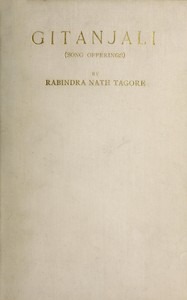
Gitanjali by Rabindranath Tagore

(24 User reviews)   7315
By Betty Young Posted on Dec 25, 2025
In Category - Digital Minimalism
Tagore, Rabindranath, 1861-1941 Tagore, Rabindranath, 1861-1941
English
Have you ever felt like your spiritual life was all checklists and obligations? That's what I was stuck in before picking up 'Gitanjali.' This isn't a story with a plot—it's a collection of 103 song-offerings from Nobel laureate Rabindranath Tagore. The 'conflict' here is beautiful and internal: the poet's restless human soul reaching for the divine, not with fear, but with the longing of a lover or a child for its parent. It’s about finding the sacred not in grand temples, but in the dust of the road and the warmth of the sun. Reading it feels like a quiet conversation with your own heart.
Share

Read "Gitanjali by Rabindranath Tagore" Online

This book is available in the public domain. Start reading the digital edition below.

START READING FULL BOOK
Instant Access    Mobile Friendly

Book Preview

A short preview of the book’s content is shown below to give you an idea of its style and themes.

and Dwijendranath, Rabindranath’s brother, who is a great philosopher. The squirrels come from the boughs and climb on to his knees and the birds alight upon his hands.” I notice in these men’s thought a sense of visible beauty and meaning as though they held that doctrine of Nietzsche that we must not believe in the moral or intellectual beauty which does not sooner or later impress itself upon physical things. I said, “In the East you know how to keep a family illustrious. The other day the curator of a museum pointed out to me a little dark-skinned man who was arranging their Chinese prints and said, “That is the hereditary connoisseur of the Mikado, he is the fourteenth of his family to hold the post.’” He answered, “When Rabindranath was a boy he had all round him in his home literature and music.” I thought of the abundance, of the simplicity of the poems, and said, “In your country is there much propagandist writing, much criticism? We have to do so much, especially in my own country, that our minds gradually cease to be creative, and yet we cannot help it. If our life was not a continual warfare, we would not have taste, we would not know what is good, we would not find hearers and readers. Four-fifths of our energy is spent in the quarrel with bad taste, whether in our own minds or in the minds of others.” “I understand,” he replied, “we too have our propagandist writing. In the villages they recite long mythological poems adapted from the Sanskrit in the Middle Ages, and they often insert passages telling the people that they must do their duties.” II I have carried the manuscript of these translations about with me for days, reading it in railway trains, or on the top of omnibuses and in restaurants, and I have often had to close it lest some stranger would see how much it moved me. These lyrics— which are in the original, my Indians tell me, full of subtlety of rhythm, of untranslatable delicacies of colour, of metrical invention—display in their thought a world I have dreamed of all my live long. The work of a supreme culture, they yet appear as much the growth of the common soil as the grass and the rushes. A tradition, where poetry and religion are the same thing, has passed through the centuries, gathering from learned and unlearned metaphor and emotion, and carried back again to the multitude the thought of the scholar and of the noble. If the civilization of Bengal remains unbroken, if that common mind which—as one divines—runs through all, is not, as with us, broken into a dozen minds that know nothing of each other, something even of what is most subtle in these verses will have come, in a few generations, to the beggar on the roads. When there was but one mind in England, Chaucer wrote his _Troilus and Cressida_, and thought he had written to be read, or to be read out—for our time was coming on apace—he was sung by minstrels for a while. Rabindranath Tagore, like Chaucer’s forerunners, writes music for his words, and one understands at every moment that he is so abundant, so spontaneous, so daring in his passion, so full of surprise, because he is doing something which has never seemed strange, unnatural, or in need of defence. These verses will not lie in little well-printed books upon ladies’ tables, who turn the pages with indolent hands that they may sigh over a life without meaning, which...

This is a limited preview. Download the book to read the full content.

Let's be clear: if you're looking for a page-turning thriller, this isn't it. 'Gitanjali' ('Song Offerings') is a collection of spiritual poems. There's no traditional plot. Instead, Tagore presents 103 short pieces that are prayers, but not the kind you're used to. They are intimate dialogues between a seeker and the divine, which he often calls his 'Lord' or 'King.' The journey is one of yearning, doubt, joy, and surrender.

Why You Should Read It

I was blown away by how accessible and human these poems feel. Tagore doesn't preach from a mountaintop; he writes from the messy, beautiful middle of life. His God is found in a farmer's field, in a mother's lullaby, and in the simple act of laying down one's burdens. The themes of love, freedom from ego, and finding joy in service hit me right in the chest. It stripped away my stuffy ideas about spirituality and replaced them with something warm and radiant.

Final Verdict

This book is a quiet companion for anyone feeling weary, over-scheduled, or spiritually disconnected. It's perfect for poetry newcomers because the language (in W.B. Yeats' celebrated translation) is stunningly clear and direct. It's also for the seeker who wants a faith that feels like love, not law. Keep it on your nightstand. Read just one poem a day. Let it be your small moment of peace.


ℹ️ No Rights Reserved

No rights are reserved for this publication. You are welcome to share this with anyone.

Liam Young
6 months ago

From the very first page, the content flows smoothly from one chapter to the next. Worth every second.

George King
8 months ago

Essential reading for students of this field.

Robert Sanchez
1 year ago

I was skeptical at first, but the content flows smoothly from one chapter to the next. A valuable addition to my collection.

Margaret Smith
6 months ago

Clear and concise.

Michelle Young
1 year ago

Based on the summary, I decided to read it and it creates a vivid world that you simply do not want to leave. I would gladly recommend this title.

4.5
4.5 out of 5 (24 User reviews )

Add a Review

Your Rating *
There are no comments for this eBook.
You must log in to post a comment.
Log in


Related eBooks