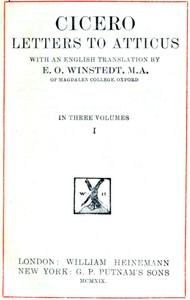
The letters in this volume open with Cicero at 38, already a seasoned politician, yet the earliest entries are sparse—only two survive from 68 BCE. The correspondence soon becomes a record of emotional and political turbulence. Cicero writes from exile in Dyrrachium, describing himself as one who must “waste away in misery,” and later, upon return to Rome, he measures his restoration by the recovery of “splendour in the forum” and “authority in the senate.” The translator, E. O. Winstedt, preserves the epistolary form with Latin and English on facing pages, and includes a table to reorder the letters chronologically, acknowledging that the traditional arrangement is not strictly historical.
A Correspondence Shaped by Absence
The letters to Atticus are not a diary but a dialogue with a trusted friend who is often far away. Cicero repeatedly urges Atticus to come to him: “Please make haste and come to me” (Letter XXVI). The physical distance between them becomes a structural device—each letter is a bid to bridge that gap. Atticus’s replies are not preserved, so the reader infers his counsel from Cicero’s responses. In Letter XXV, Cicero thanks Atticus for his frankness: “however unpleasant the truth may be, I am grateful for it.” This asymmetry gives the collection a one-sided urgency, as if Cicero is speaking into a void, hoping for a reply that will change his fortunes.
Recurring Images of Ruin and Restoration
Cicero’s language is saturated with metaphors of collapse and rebuilding. In exile, he writes that he must “waste away” and speaks of “ruin beyond redemption.” Upon returning, he describes his restored position as a recovery of “splendour” and “authority.” The word reditus (return) echoes through the later letters, and Cicero frames his restoration as a kind of rebirth. Yet he also admits that his private finances remain precarious, and he worries that his public standing may not last. This oscillation between hope and despair is not merely personal; it mirrors the instability of the late Republic, where political favour could vanish overnight.
Movement Between Scenes: Rome, Exile, and the Road
The letters trace a geography of power. Cicero writes from Rome, from Dyrrachium, and from the road. The shift from the city to exile is abrupt: after a gap in the correspondence, he is suddenly in Dyrrachium, begging Atticus to visit. The return journey is marked by letters that mix relief with anxiety. In Letter I of Book IV, written from Rome, Cicero says that only Atticus’s embrace is missing from his joy. The physical movement—from the centre to the periphery and back—structures the volume. Each change of location signals a change in Cicero’s political standing, and the letters themselves become waypoints on a map of his fortunes.
The Translator’s Hand: Notes, Chronology, and Text
Winstedt’s edition is a scholarly tool. He bases his text on the Teubner edition but revises it against more recent work, and he provides textual notes only where the reading is “especially corrupt or uncertain.” The introduction acknowledges debts to Tyrrell and Shuckburgh. A chronological table at the end allows readers to reorder the letters historically, since the traditional sequence is not strictly chronological. This editorial apparatus highlights the fragmentary nature of the correspondence: the letters from Cicero’s consulship and the Catilinarian conspiracy are entirely missing. Winstedt’s notes are minimal, letting Cicero’s voice dominate, but the table and introduction remind us that what survives is only a selection.
Reading these letters in sequence, one is struck by how much is left unsaid. Atticus’s responses are absent, and the gaps in the record—especially the missing consular letters—force the reader to piece together events from Cicero’s allusions. The volume rewards attention to repeated words and shifts in tone, from the frantic pleas of exile to the measured satisfaction of return. It is a portrait of a man trying to control his own story through correspondence, even as events slip beyond his grasp.
Reading Cicero's wavering between hope and ruin, I remembered late nights with my own old letters, their faded ink. Something in his fear of exile reminded me of how I felt, years ago, holding Calvin’s correspondence for the first time. That same ache of a man trying to hold his world together from a desk. See Letters of John Calvin, Volume II Compiled from the Original Manuscripts and Edited with Historical Notes — Context and Discussion, and it returns quietly, like an old friend’s voice.